



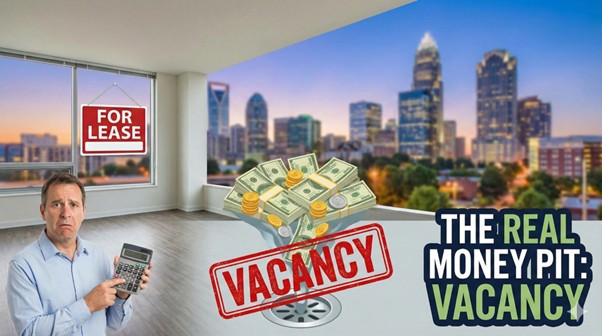
You know what's funny? Most Charlotte landlords spend hours obsessing over tenant screening, running background checks, and worrying about late rent payments. Meanwhile, the real cash drain sits quietly in the shadows, eating away at profits month after month.
It's not your tenants. It's vacancy.
Every day your Charlotte rental property sits empty costs you money. Not hypothetical money or future money, but actual cash that should be in your bank account right now. And if you're managing your property yourself or working with the wrong property manager, you're probably hemorrhaging more than you realize.
The Math That Nobody Wants to Do
Let's say you own a rental in South End that pulls in $2,000 a month. Seems straightforward, right? But here's what one month of vacancy actually costs you:
Lost rent: $2,000. Mortgage payment you still have to cover: another $1,500. Utilities while the place sits empty: $150. Marketing costs to find a new tenant: $300 to $500. Not to mention the cleaning, minor repairs, and your time showing the property.
Suddenly, that one vacant month isn't just $2,000. It's closer to $4,000 or more in actual costs and lost revenue.
According to experts at https://theearnesthomes.com/, delayed maintenance and unclear lease terms account for 78% of avoidable turnover costs. That number should make you pause. Most of the expensive problems landlords face aren't acts of nature or bad luck. They're preventable.
Why Vacancy Happens (And Why It's Worse Than You Think)
The average turnover cost for a rental property ranges between $1,000 and $5,000, with industry reports pegging the 2023 average at $3,872 per unit. In Charlotte's competitive market, where properties can sit vacant for weeks during turnover, the stakes are even higher.
Tenant turnover is expensive for a few reasons. First, there's the gap between when one tenant moves out and another moves in. Even if you're quick about it, you're looking at two to four weeks minimum. That's half a month's rent, gone.
Then there's the condition of the property. Maybe your previous tenant was great, maybe they weren't. Either way, you need to clean, paint, patch holes, replace filters, and generally make the place presentable again. Those costs add up faster than you'd expect.
And here's the kicker: while you're scrambling to get the property ready and listed, the Charlotte rental market keeps moving. Properties that sit too long start to look suspicious to prospective tenants. Why hasn't anyone rented it yet? What's wrong with it?
The Hidden Cost of DIY Property Management
Many Charlotte landlords choose to self-manage their properties. It makes sense on paper. Why pay a property manager 8 to 10 percent of your monthly rent when you could keep that money?
Here's why: because managing a rental property takes time, expertise, and a whole network of reliable contractors. When your water heater breaks at 9 PM on a Saturday (and it will), do you have a plumber on speed dial who won't charge you triple? When it's time to screen tenants, are you running comprehensive background checks, employment verification, and rental history reviews? Or are you just hoping for the best?
Property managers earn their fees by preventing the expensive problems that wipe out your profits. They know how to price your rental competitively without leaving money on the table. They understand rental property maintenance costs, which typically run about 1 to 2 percent of your property's value annually. For a $300,000 home, that's $3,000 to $6,000 per year.
More importantly, experienced property managers know how to keep tenants happy enough to renew their leases. And tenant retention is where the real savings happen.
Tenant Retention: The Profit Strategy Nobody Talks About
Think about it this way. If you have a tenant who stays for three to five years, you're avoiding all those turnover costs multiple times over. No vacancy periods. No repainting. No re-marketing. No tenant placement fees.
Keeping good tenants isn't rocket science, but it does require attention. It means responding quickly to maintenance requests. Being fair about rent increases. Treating tenants like valued customers rather than necessary evils.
Property managers understand this. They've built systems around tenant retention because they know it's cheaper to keep a good tenant than to find a new one. They send lease renewal reminders 45 days before expiration. They handle maintenance requests within 24 hours. They communicate clearly and professionally.
To be fair, not every landlord needs a property manager. If you own one rental property, live nearby, and genuinely enjoy the work, managing it yourself might make sense. But if you own multiple properties, or if you're treating your rentals as investments rather than hobbies, the math changes.
What Actually Moves the Needle
Charlotte's rental market continues to evolve. Properties near the LYNX Blue Line command higher rents because of commuter convenience. Neighborhoods like NoDa, Plaza Midwood, and Dilworth attract different tenant demographics with different expectations. And as more investors look beyond the city center, areas like Lake Norman are becoming increasingly attractive for the future of rentals in the greater Charlotte region.
Pricing your rental correctly matters more than almost anything else. Set the rent too high, and your property sits vacant while you bleed money. Set it too low, and you're leaving cash on the table every single month.
The sweet spot? It requires knowing the local market, understanding comparable properties, and adjusting for features like parking, pet policies, and amenities. It's not guesswork. It's data.
Professional property managers use comparative market analysis to determine pricing that balances profit with occupancy speed. They know that overpricing by even $50 can drive away qualified tenants who have plenty of other options. In Charlotte's current rental market, where average rents hover between $1,600 and $2,000 depending on the property type, precision matters.
The Maintenance Trap
Here's another truth that hurts: deferred maintenance costs you more than proactive maintenance. Always.
That small leak you've been meaning to fix? It's going to become water damage, mold remediation, and possibly a legal liability when your tenant gets sick. The HVAC system you're nursing along? It's going to die during the hottest week of summer, forcing you to pay emergency rates for a replacement.
Property managers build regular maintenance into their operations. They schedule HVAC inspections, gutter cleanings, and system checks before things break. They have relationships with contractors who show up quickly and charge fair prices.
You might be thinking, "But that costs money!" It does. Less money than emergency repairs, tenant complaints, negative reviews, and the vacancy that follows when your frustrated tenant moves out.
Making the Numbers Work
Let's get practical. If you're paying a property manager 8 percent of your monthly $2,000 rent, that's $160 per month or $1,920 per year. Seems like a lot, right?
Now consider what that $1,920 buys you:
Professional tenant screening that reduces your risk of problem tenants. Market-rate pricing that keeps your property competitive and occupied. 24/7 maintenance coordination with vetted contractors. Lease renewal management that keeps good tenants in place. Legal compliance with North Carolina landlord-tenant laws. Financial reporting and rent collection that runs like clockwork.
Compare that to the cost of one month of vacancy ($4,000), one major maintenance emergency ($2,000+), or one bad tenant who trashes your property and skips out on rent ($10,000+).
The property manager's fee doesn't look quite so expensive anymore, does it?
What Charlotte Landlords Actually Need
Success in Charlotte's rental market comes down to a few key factors: competitive pricing, quick response times, quality tenant screening, and proactive maintenance. Whether you handle these yourself or work with professionals, these basics don't change.
The question isn't whether these things matter. They obviously do. The question is whether you have the time, expertise, and systems to execute them consistently. Or perhaps more honestly, whether you want to.
Some landlords genuinely enjoy property management. They like choosing tenants, coordinating repairs, and staying hands-on with their investments. If that's you, more power to you. Just make sure you're actually good at it, because your tenants and your bottom line will tell you the truth eventually.
For everyone else, working with experienced property managers who understand the Charlotte market isn't an expense. It's an investment that typically pays for itself by reducing vacancy, avoiding costly mistakes, and keeping quality tenants in place longer.
The Real Bottom Line
Your biggest risk as a Charlotte landlord isn't bad tenants. It's empty units, deferred maintenance, and the slow bleed of inefficiency. Those vacant days add up. The emergency repairs compound. The preventable mistakes accumulate.
You can address these issues yourself if you have the knowledge and bandwidth. Or you can work with professionals who've built their entire business around solving these exact problems.
Either way, stop worrying so much about tenants and start paying attention to vacancy. That's where your real money pit lives. And unlike tenants, vacancy doesn't even pretend to pay rent.
If you're looking to reduce vacancy, streamline maintenance, and improve your rental property's performance in Charlotte, Bottom Line Property Management offers comprehensive property management services designed to keep your properties occupied and profitable. The team understands the local Charlotte market and has systems in place to minimize the costly gaps that eat into landlord profits.