



Shopping for business fiber in Tennessee takes more than scanning advertised speeds. First, decide whether you need shared FTTP or dedicated internet access, then insist on a written SLA, and proof the carrier can light your exact suite. This guide sizes up the five best business fiber providers in Tennessee, shows where each one shines, and clarifies when best-effort bandwidth is enough, and when it’s worth paying for a dedicated pipe. Think of it as advice from a seasoned IT friend: plain English, clear steps, no fluff.
Quick answer: the best Tennessee business fiber providers
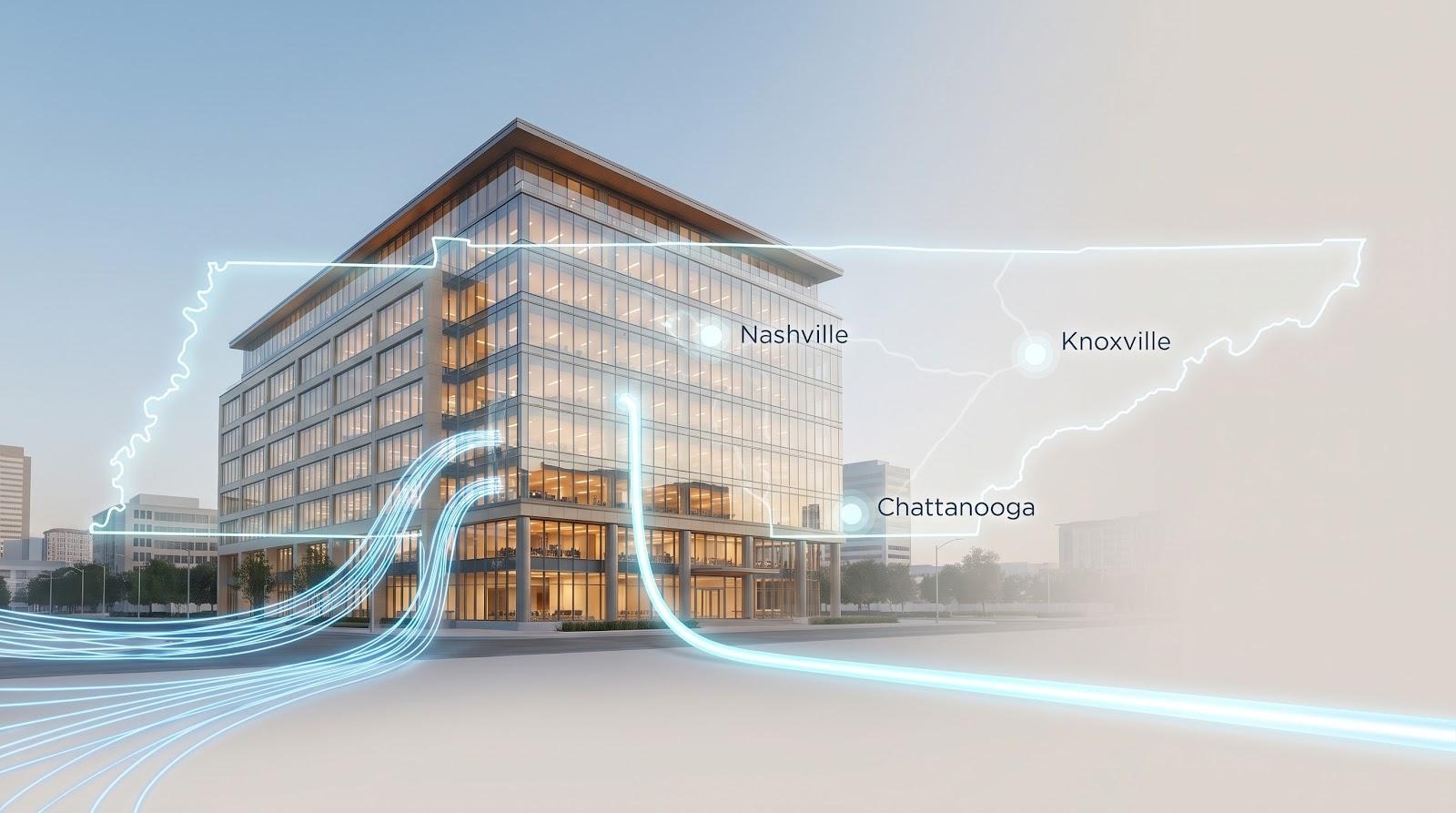
Here’s the fast lane if you want names before the technical deep dive. We scored every major carrier on true fiber reach, business-class support, and Tennessee availability, then paired each one with the scenario where it shines. Scan the chart, find the row that matches your address, and you’re halfway to a shortlist.
Best for | Provider | Circuit type | Max symmetrical speed | Starting published price* | SLA headline | Primary Tennessee market |
Shared-to-dedicated upgrade path | WOW! Business† | HFC (shared) or fiber DIA | 10 Gbps (DIA) | 600 Mbps $65.99 promo | 99 percent network reliability | Knoxville |
Broad statewide mix | AT&T Business | Shared FTTP and DIA | 1 Tbps (DIA) | 300 Mbps $70 | 100 percent service-availability guarantee | Statewide metros |
Chattanooga municipal value | EPB | Shared FTTP + guaranteed-bandwidth add-on | 100 Gbps (business) | 300 Mbps $75 | Paid SLA upgrade | Chattanooga |
Knoxville municipal value | KUB Fiber | Shared FTTP + custom DIA | 2.5 Gbps (shared) | 500 Mbps $85 | Custom Connect Pro SLA | Knoxville |
No-contract Nashville fiber | GFiber Business | Shared FTTP | 2 Gbps | 1 Gbps $100 | 99.9 percent with 25 percent auto credit | Nashville |
*Monthly rates current as of September 3, 2026; taxes, fees, and add-ons extra. AT&T online orders are $10 less on the 300, 500 and 1 Gig tiers.
†WOW!’s dedicated fiber is address-dependent. If your Knoxville site isn’t on-net, swap in Brightspeed Business for comparable DIA service.
Use this table as a launch pad. Up next: when shared fiber is plenty, when you truly need dedicated internet access, and how each provider performs on install time, uptime, and total cost.
Shared business fiber or a dedicated circuit: what do you need?
What shared business fiber means
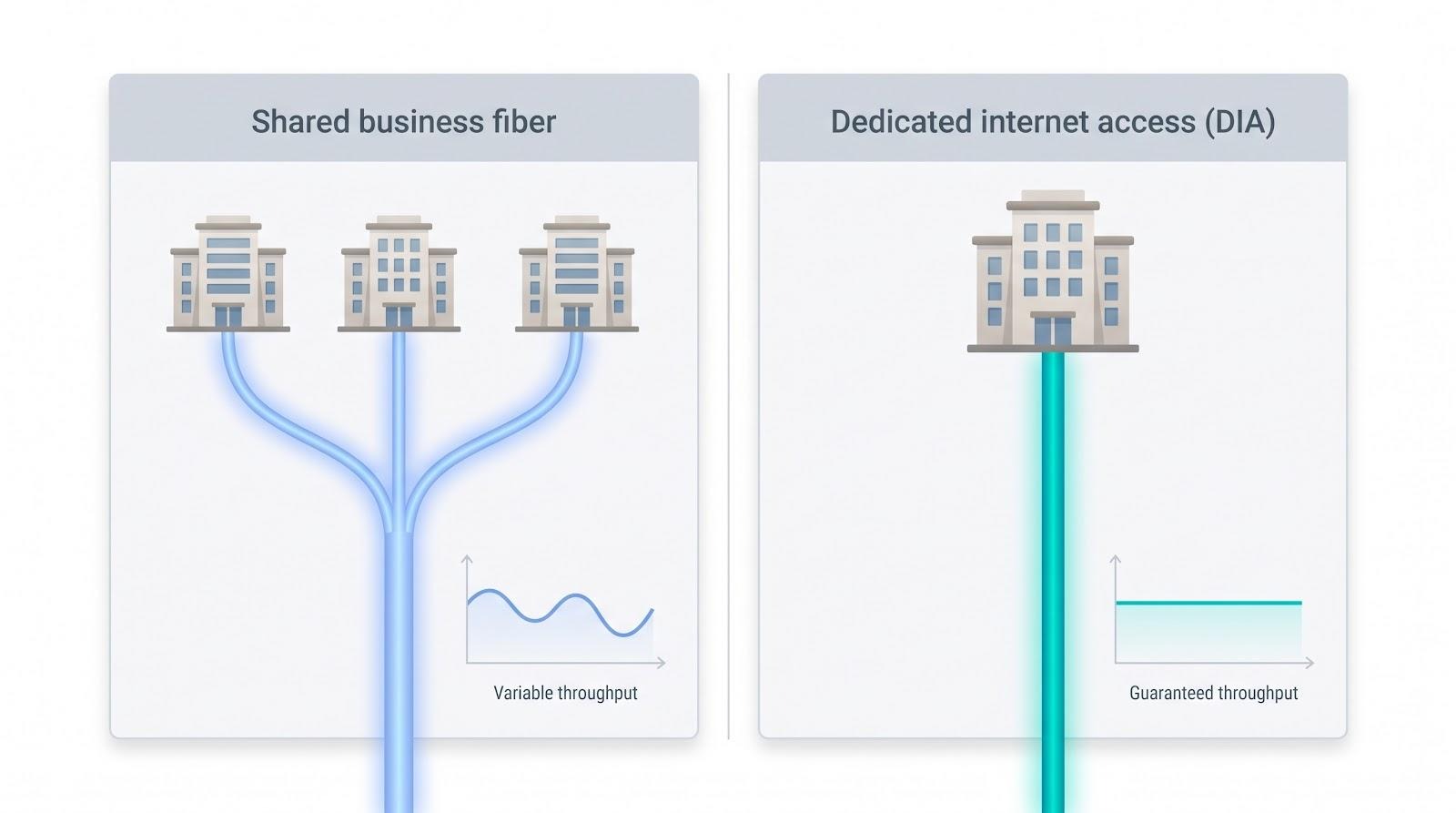
A shared fiber line brings glass all the way to your suite, so you enjoy symmetrical uploads and low latency. Upstream, however, dozens of businesses split the same capacity. When everyone pushes large files at lunch, throughput can dip, similar to a transit lane that slows when too many cars crowd in.
Most Tennessee carriers label this tier “Business Fiber” or “Gigabit Broadband.” If the building is already on-net, setup is quick and the contract is often month to month. For retailers running cloud point-of-sale or design teams syncing Creative Cloud, that price-to-performance ratio is hard to beat. The trade-off is predictability: you get best-effort bandwidth and a modest uptime promise, typically around 99.9 percent (about 44 minutes of allowable outage each month).
What dedicated internet access means
Dedicated internet access (DIA) reserves the entire pipe for your company. Buy 1 Gbps, and you receive that gigabit every hour of the day. Carriers back the commitment with written metrics (uptime, latency, jitter, and packet loss). AT&T, for example, guarantees 100 percent service availability and lets you request a service credit whenever the circuit goes down.
That assurance costs more. Quotes factor in distance to existing fiber, construction hurdles, and the speed you commit to. An on-net DIA install may finish in a few weeks; trenching new conduit can push delivery past 60 days.
Bottom line: choose DIA when four nines (99.99 percent, roughly 4 minutes of monthly downtime) or strict compliance rules justify the premium. Stick with well-priced shared fiber when everyday SaaS, VoIP, and cloud collaboration run fine on best-effort service.
How we ranked Tennessee business fiber providers
Generic “top-10” lists recycle press releases. We built a 100-point scorecard and required each carrier to clear seven evidence-based hurdles:
Criterion | Weight (points) | What we verified |
Tennessee footprint | 20 | On-net or near-net business addresses, not just statewide ads |
Circuit quality | 15 | True FTTP versus “fiber-powered” coax, plus availability of both shared and dedicated service |
Service-level agreements | 20 | Written uptime, latency, jitter, and packet-loss guarantees with automatic credits |
Price transparency | 15 | Public monthly rates or clearly disclosed promo terms |
Installation and construction | 10 | Typical lead time, right-of-entry friction, and construction fees |
Business extras | 10 | Static IP blocks, 5G failover, managed security, local support |
Recent Tennessee investment | 10 | New fiber builds, BEAD participation, or network upgrades since 2025 |
These criteria sorted the “best for” lineup that follows. The aim is not popularity; it is a practical field guide for companies whose revenue depends on a live, fast connection.
1. WOW! Business: best Knoxville path from shared to dedicated
WOW! lets Knoxville companies start on a bargain shared plan, then step up to dedicated fiber when file sizes or financial risk outgrow best-effort bandwidth.
The coax-based Business Internet promo starts at 600 Mbps (760 Mbps down / 51 Mbps up at 11 ms typical latency on the FCC label) for $65.99 a month, with 1.2 Gbps (1,700 Mbps down / 60 Mbps up at 11 ms) for $5 more at $70.99.* A 300 Mbps tier is offered but the Knoxville page does not publish its promotional price; the standing no-contract rate on the FCC label is $79.99 (370 Mbps down / 21 Mbps up). These promotional rates require a term agreement (the Knoxville page advertises a 1-year term) and early termination fees apply; third-party listings put the fee at 75 percent of the remaining contract, so get the formula in writing. If you prefer no contracts, WOW! offers standing month-to-month rates (for example, 600 Mbps for $89.99) that include unlimited data. Those asymmetric uploads work fine for point-of-sale traffic, VoIP handsets, and cloud file sync, but not for pushing multi-gig video renders on a deadline.
Need guaranteed performance? WOW!’s dedicated internet access runs at speeds up to 10 Gbps, delivered over ethernet or fiber. While WOW! advertises a 99 percent network reliability target, note that this is not a formal 99.9 percent SLA with automatic bill credits. Because the pipe is private, a noon file transfer never contends with the retailer next door.
Important caveat: WOW!’s published Premium Fiber map currently omits Tennessee. (Where available, Premium Fiber offers five symmetrical plans up to 5,078 Mbps down / 4,446 Mbps up with 4-5 ms latency for $70-$310 per month.) Ask the rep for an on-net confirmation email, a redacted DIA quote, or a list of lit buildings. If they cannot prove fiber at your address, place Brightspeed or AT&T on the RFP short list instead.
Before signing, request the full terms, including uptime targets, restoration timelines, and exclusions, plus written installation charges, construction timelines, and add-on pricing so an attractive monthly rate does not swell later. For example, WOW! add-ons include a Static IP for $14.99 per month, Whole-Business WiFi for $19.99 per month, and Wireless Internet Backup (Cradlepoint E100 with optional 8- to 16-hour battery) for $44.99 per month. Standing rates require a $99 one-time install and an $11 per-month modem fee, although promotional terms often include free installation and a free modem for the first three months.
WOW! Business describes its scalable business fiber internet services, including dedicated internet access up to 10 Gbps, but Knoxville businesses should verify exact-building fiber eligibility before requesting a quote.
Ideal fit: Knoxville small or midsize firms that want an inexpensive shared circuit now and a smooth runway to DIA later, without switching carriers.
*Promotional prices current as of September 3, 2026; taxes, fees, and term conditions apply.
2. AT&T Business: best statewide blend of shared fiber and DIA
AT&T is the lone carrier on our list that can serve nearly any Tennessee ZIP code with either quick-install shared fiber or a one-terabit dedicated circuit, a notable edge if you manage multiple locations or expect to outgrow a single office.
Shared Business Fiber. Plans start at 300 Mbps for $70 a month ($60 when ordered online) and top out at 5 Gbps. There is no annual contract, the gateway is included, and 1 Gbps-and-higher tiers ship with an LTE/5G failover modem that switches over automatically when fiber light drops. The modem still needs power, and AT&T notes that failover traffic does not carry static IP blocks or hosted-voice trunks.
Dedicated Internet Access. DIA ranges from 10 Mbps to 1 Tbps and carries a 100 percent uptime guarantee (zero minutes of allowable downtime) with service credits you request when it misses. Contracts also cap latency, jitter, and packet loss, so voice packets and database syncs stay predictable. AT&T can deliver 40 Gbps or 100 Gbps without third-party transport, a capacity few rivals match.
Installation. On-net shared service often activates in a few business days; new DIA builds can run 60-120 days if crews must pull fiber from the street. Nail down the firm order-commitment date and any construction fees before signing.
Why pick AT&T over a municipal plan?
Statewide reach. One provider, one bill, and one support portal for Nashville, Knoxville, Chattanooga, and rural branches.
Scalability. Very few carriers will sell a customer-controlled 40 Gbps or 100 Gbps pipe, let alone 1 Tbps, without outside transport. AT&T already has that capacity in-house.
Ideal fit: multi-location businesses that want a single account team today and the freedom to toggle between shared and dedicated service as stakes rise.
3. EPB: best municipal fiber in Chattanooga
EPB owns the poles, conduit, and last-mile fiber across Chattanooga, so it controls every part of the network path. With that control, latency inside Chattanooga is low and outages are rare even at peak hours.
Transparent pricing
300 Mbps: $75
500 Mbps: $115
1 Gbps: $155
No teaser rates, data caps, or surprise renewals. EPB sells business fiber from 300 Mbps up to 100 Gbps, and it posts its SLA add-on openly: $150 a month on 300 Mbps, $350 on 500 Mbps and $650 on 1 Gig, plus $25 a month for a static IP.
Paid SLA details
Exact uptime percentage and how it is measured.
Restoration-time commitment in hours.
Whether planned maintenance counts against the tally.
Installation and support
Most on-net addresses schedule fiber drop and activation in a single visit. Technicians label the demarc clearly, a plus when you add a second carrier for redundancy.
Caveat
No single-provider network is immune to a conduit strike. Mission-critical sites should still order a backup circuit (AT&T Dedicated Internet or Segra are common pairings).
Ideal fit: Chattanooga companies that want enterprise-grade reliability and local 24/7 support without enterprise-grade pricing.
4. KUB Fiber: best Knoxville municipal value
Knoxville Utilities Board built its own fiber network and priced it aggressively. Business tiers are 500 Mbps for $85, 1 Gbps for $150, and 2.5 Gbps for $225, all symmetrical with unlimited data and no promotional countdowns.
Business perks
Static IP addresses: ask; KUB does not list them on the plan page.
Managed Wi-Fi runs $20.
Local support routes calls to KUB’s own Knoxville call center rather than a national queue.
When you outgrow shared fiber, Custom Connect Pro can quote dedicated or redundant service with an enterprise SLA; ask for the written uptime target, restoration window, and credit formula because they are not posted publicly.
Installation. After the landlord signs the right-of-entry form, ask KUB for a written activation window; it does not publish a standard lead time. Crews label the demarc and record light levels before leaving, a handy reference if you ever troubleshoot a firewall.
Coverage caveat. The footprint hugs Knoxville city limits and a few suburbs. Warehouses in Blount County, for example, will need AT&T, Comcast, or a Segra DIA quote instead.
Ideal fit: Knoxville offices, retailers, and medical practices that want symmetrical gigabit speeds, transparent pricing, and local support on speed dial.
5. GFiber Business: best no-contract shared fiber in Nashville
GFiber keeps the menu simple: 1 Gig for $100 and 2 Gig for $250 a month, both month to month with equipment, installation, and unlimited data included. No promo countdowns, no bundle rules, just a flat rate on a symmetrical line.
The 2 Gig tier carries a 99.9 percent uptime guarantee, equal to about 44 minutes of allowable outage per month. If performance slips, the portal auto-credits 25 percent of the bill without a support ticket. The 2 Gig plan includes a single static IP; on 1 Gig, static addressing is an add-on.
Coverage caveat. GFiber lights large swaths of Davidson County but skips some fringe business parks. Run your exact address through the qualification tool before penciling delivery dates into the project plan.
Ownership note. In March 2026 GFiber and Astound Broadband announced a pending merger under majority owner Stonepeak, with closing targeted for late 2026. Alphabet will remain a minority investor, but product names, pricing, or support channels could change. A month-to-month contract gives you an easy exit if post-merger terms do not fit.
Ideal fit: Nashville startups and agencies that want symmetrical gigabit speeds, no long-term contract, and a built-in 25 percent credit if uptime slips.
Side-by-side comparison at a glance
Here’s the scoreboard. Use it to match your address and risk tolerance to the right provider before you dig into SLA fine print.
Provider | Primary TN market | Last-mile type | Circuit offered | Max symmetrical speed | Starting monthly price* | Contract term | Uptime/SLA headline | Static IP | Built-in failover |
WOW! Business | Knoxville | Coax (shared) or fiber DIA | Shared FTTP†, DIA | 10 Gbps (DIA) | 600 Mbps $65.99 promo | Month to month (standing) or 1 yr (promo) | 99% network reliability (not an SLA) | $14.99/mo | $44.99/mo wireless add-on |
AT&T Business | Statewide metros | FTTP shared / fiber DIA | Shared, DIA | 1 Tbps (DIA) | 300 Mbps $70 | Month to month shared / 12-36 mo DIA | 100% uptime, credit on request | Add-on | LTE/5G on ≥ 1 Gbps |
EPB | Chattanooga | FTTP | Shared, guaranteed BW | 100 Gbps (business) | 300 Mbps $75 | Month to month | Paid SLA upgrade | Yes | None |
KUB Fiber | Knoxville | FTTP | Shared, dedicated quote | 2.5 Gbps (shared) | 500 Mbps $85 | Not published | Custom Connect SLA | Ask | None |
GFiber Business | Nashville | FTTP | Shared only | 2 Gbps | 1 Gbps $100 | Month to month | 99.9% with 25% auto credit (≈ 44 min/mo) | 2 Gb tier | None |
*Rates current as of September 3, 2026; taxes, fees, and optional add-ons extra.
†WOW!’s shared service uses coax for the final drop; confirm symmetrical fiber eligibility before ordering DIA.
Scan the row that matches your market, note the contract style you can accept, then verify SLA details in the provider’s written agreement before signing.
Where business fiber is available in Tennessee
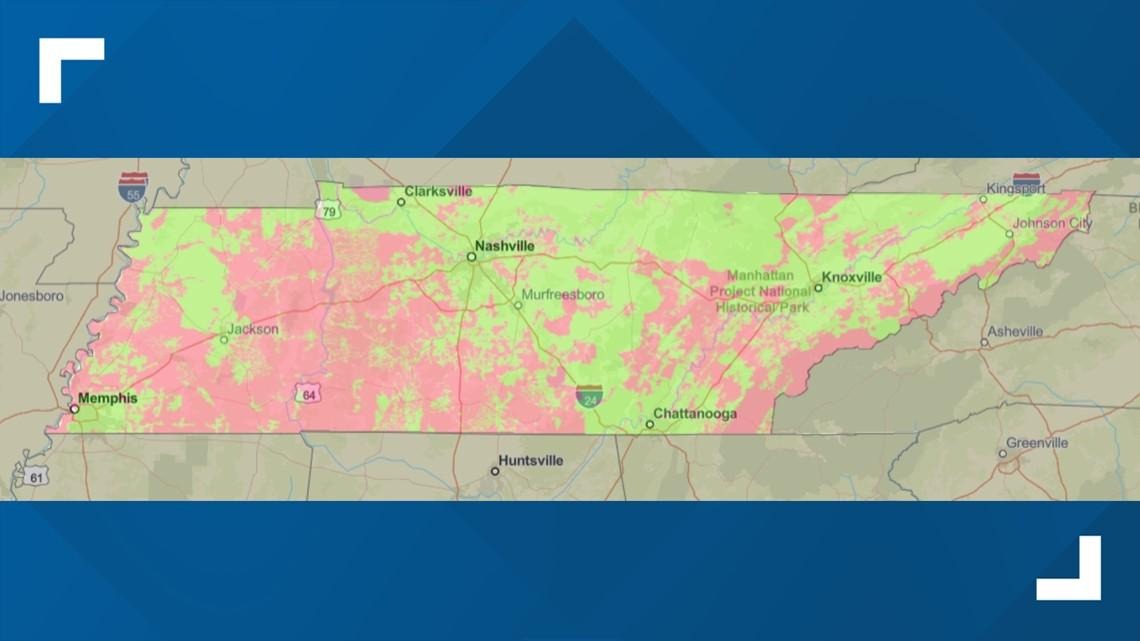
Broadband coverage map of Tennessee.
Nashville: plenty of shared fiber, but plan for a dedicated backup
AT&T Business Fiber and GFiber overlap across much of Davidson County, giving offices a choice among price, SLA, and built-in 5G failover. Spectrum Enterprise and Segra sell dedicated fiber downtown, while AT&T or Comcast can extend DIA to many suburbs when the address sits near existing conduit.
Coverage still changes block by block. GFiber’s map remains a patchwork of green and gray, and some warehouse districts near Antioch or Madison fall back to copper or fixed wireless. Run both availability tools, then confirm with a live sales rep before setting delivery dates. Once the primary circuit is lit, budget a second feed on a separate entrance path; the cost is minor compared with an outage during CMA Fest or holiday retail peaks.
Knoxville: KUB Fiber inside the loop, multi-carrier DIA outside
Inside KUB Fiber territory, 1 Gbps symmetrical costs $150 with unlimited data, an impressive value. Outside that footprint, options flip to AT&T shared fiber, WOW! coax, or a Segra DIA quote. For redundancy, pair KUB with a WOW! or AT&T DIA circuit on a different lateral and UPS-backed gear; a single truck strike can still sever both feeds if they share poles or conduit.
Chattanooga: EPB as primary, plus a physically diverse second circuit
Downtown buildings are often EPB-lit already, and technicians can activate 1 Gbps within days. Even a utility-owned network can lose a route to a construction mishap. Order a standby circuit (AT&T Dedicated Internet or Segra are common) on a separate entrance and test automatic failover under load before sign-off.
Tri-Cities and northeast Tennessee: Segra for DIA, Brightspeed or cooperatives for shared fiber
Kingsport, Johnson City, and Bristol offer fewer choices. Segra’s business-only fiber covers many industrial parks but is quote-only. Brightspeed is still building fiber across its Tennessee footprint and markets business tiers from 200 Mbps to 8 Gbps with a 99.95 percent Premium Fiber SLA; availability still swings street by street. Electric cooperatives such as BrightRidge or Cumberland Connect fill rural gaps with symmetrical gigabit plans priced well below carrier DIA, though SLAs and static-IP options are thin. Use a cooperative circuit as backup to a Segra or AT&T DIA feed if uptime is critical.
Bottom line: metro addresses enjoy multiple shared-fiber options, but dedicated or redundant service still hinges on exact building qualification and physically diverse routes. Always verify coverage in writing and plan power resilience alongside bandwidth.
How much does business fiber cost in Tennessee?
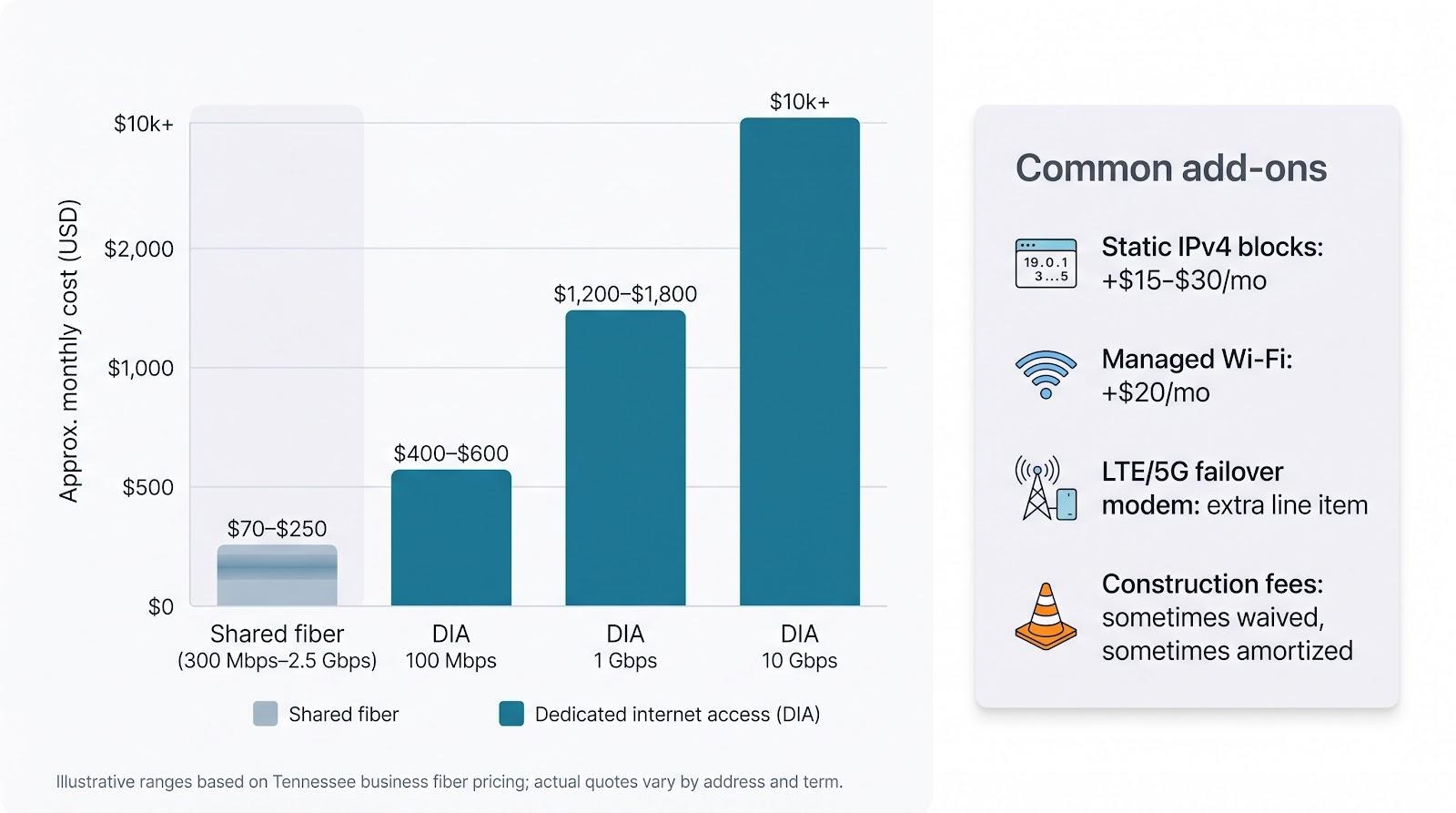
Shared municipal or provider fiber typically runs $70-$250 a month for 300 Mbps to 2.5 Gbps. Public examples: EPB posts 1 Gbps for $155, KUB sells 2.5 Gbps for $225, and AT&T lists 300 Mbps for $70 with no promo timer.
Dedicated internet access sits in a different bracket. In Knoxville or Nashville a 100 Mbps DIA circuit often quotes at $400-$600 after access fees and taxes. 1 Gbps DIA usually lands between $1,200 and $1,800, and 10 Gbps quotes can top $10,000. Variance comes from distance to backbone, required construction, and contract term.
Hidden costs to ask about
Static IPv4 blocks: $15-$30 per month
Managed Wi-Fi (KUB): $20 per month
LTE/5G failover modem (AT&T): separate line item when static IP routing is needed
Construction fees: sometimes waived, sometimes amortized
Bottom line: a shared municipal gigabit can cost no more than cable. When uptime is mission-critical, budget four to six times more for DIA, and be ready to explain every avoided-downtime minute to finance.
How to read a business internet SLA
A service-level agreement feels like boilerplate until packets stop. Every clause decides whether you earn a credit or absorb the loss. Here’s the checklist we use when reviewing a carrier’s SLA.

Uptime math.
99.9 percent allows about 44 minutes of outage per month.
99.99 percent trims that to 4.4 minutes.
AT&T Dedicated Internet advertises 100 percent availability with credits on request, while GFiber’s Business 2 Gig plan promises 99.9 percent plus a 25 percent bill credit when it misses the mark. Convert each percentage to minutes, and ask whether that tolerance matches payroll, cart abandonment, or patient-care risk.
Exclusions.
Most carriers carve out planned maintenance, customer-side power loss, and force majeure. Some also excuse “third-party fiber cuts,” potentially leaving you offline for hours without remedy. Push for tighter wording, or add a second circuit on a different route.Performance metrics.
Look for hard ceilings: latency under 25 ms round-trip, jitter under 5 ms, and packet loss below 0.1 percent, plus credits when numbers drift. Shared broadband rarely specifies these figures, but dedicated circuits usually do.Response versus restoration.
Mean time to respond locks in when support first engages; mean time to restore determines how long you are dark. Get both in writing, with the clock running 24/7 and expressed in hours, not “commercially reasonable” language.
Treat an SLA like insurance: document every promise before the first strand of fiber hits your server room.
Other Tennessee fiber providers worth a quote
The five headliners fit most scenarios, but Tennessee’s patchwork geography means another name may win at a specific address or serve as a backup circuit.
Brightspeed. The carrier is still expanding fiber across its 20-state footprint, Tennessee included, and markets business tiers from 200 Mbps to 8 Gbps plus a Premium Fiber plan with a 99.95 percent uptime SLA. Pricing is quote-only.
Comcast Business. Standard plans ride hybrid fiber-coax, while Dedicated Internet scales into the multi-gigabit range over fiber with an SLA; ask Comcast for the current speed ceiling and credit schedule in writing. Optional managed-security bundles appeal to enterprises that want one vendor across multiple states.
Spectrum. Small-business tiers use coax and cap uploads at about 35 Mbps. Spectrum Enterprise can deliver up to 100 Gbps fiber with a 100 percent uptime guarantee. Treat the coax product as budget only; head straight to Enterprise when upload speed or SLA matters.
Regional specialists
Segra: strong DIA footprint in the Tri-Cities
TDS: active in west-Knoxville suburbs
Frontier: limited Cookeville fiber pockets
United Communications: rural Middle Tennessee
All are quote-only; local telecom brokers track weekly build maps and can sanity-check construction fees.
Electric cooperatives. Networks such as BrightRidge and Cumberland Connect sell symmetrical gigabit plans priced well below carrier DIA. SLA language and static-IP options vary, so confirm both before signing. Cooperative circuits make cost-effective backups alongside a Segra or AT&T DIA primary.
Bottom line: if your address sits outside a municipal grid, or you need route diversity, start with Brightspeed, Comcast, or Spectrum Enterprise, then layer in regional carriers or cooperative fiber for price or redundancy.
What speed does a Tennessee business need?
Bandwidth is not bragging rights; it is workflow insurance. Match the line to how your team moves data, not the biggest number on the flyer.
100-300 Mbps shared fiber covers a boutique law firm syncing cloud documents, running VoIP handsets, and hosting an occasional video meeting, roughly 5-10 Mbps per active HD stream.
500 Mbps to 1 Gbps fits offices that add guest Wi-Fi, daily cloud backups, or half a dozen simultaneous HD meetings. Creative agencies moving high-res photos and medical clinics shuttling imaging files belong here.
Multi-gig (2-10 Gbps) makes sense only when heavy data rules the day: video post-production exporting 4K files, CAD shops uploading multi-gig assemblies, or SaaS builds moving containers nonstop. Audit switches, firewalls, and access points first; a 2.5 Gbps plan still bottlenecks on 1 GbE hardware.
Dedicated vs. shared. A 1 Gbps DIA circuit with guaranteed capacity often outperforms a cheaper 2 Gbps shared link during peak hours because there is no contention. When every dropped packet costs real money (think contact centers, trading desks, or hospital telemetry), choose a smaller speed tier with stronger commitments.
Rule of thumb: buy the slowest tier that keeps uploads, backups, and video calls under ≈ 70 percent peak utilization. Higher and you pay for headroom you never tap; lower and the lunchtime Zoom may freeze when the new client joins.
Installation and redundancy checklist
A flawless installation matters as much as the quote. Work through each step before the first shovel hits dirt.
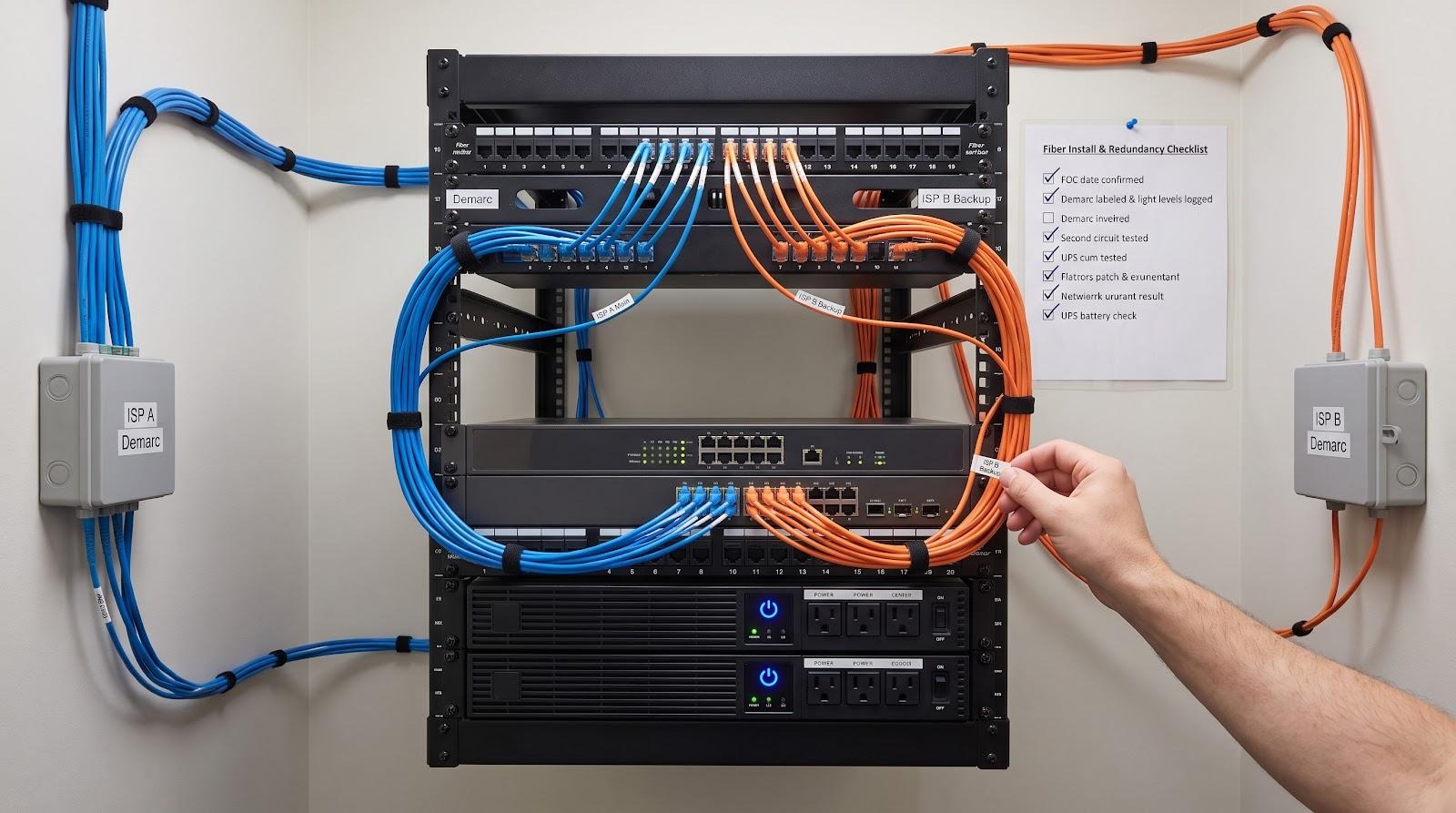
Confirm on-net status. Get the carrier’s statement (on-net, near-net, or off-net) in writing; it drives construction cost and timeline.
Lock the FOC date. A firm order-commitment date sets the ready-for-service day; without it, a “4-6-week” estimate can drift for months.
Pin down construction fees. Secure a dollar figure for trenching, boring, and building entry, and write overruns into the provider’s risk column.
Walk the route. Join the field tech, trace the path from pole or vault to demarc, and eliminate single points of failure now, not after the first outage.
Label the demarc and record light levels. Snap a photo of the patch panel and launch-meter reading; six months from now it can settle blame in minutes.
Power every link. Size UPS units for the ONT, switch, firewall, Wi-Fi, and VoIP gear; test runtime rather than assuming “looks good” equals three-hour resilience.
Order a second circuit on a diverse path. Choose a different carrier, entrance, and conduit; anything less invites shared points of failure.
Test failover under load. Pull the primary plug at noon during active video calls; watch sessions roll over, or expose gaps while it is safe to fix them.
Document and train. Update diagrams, label ports, and brief the help desk; redundancy fails if no one knows which link feeds what.
Complete these nine steps and the new fiber circuit becomes an asset, not another fire drill waiting to ignite.
Trends changing Tennessee business fiber in 2026
BEAD funding leaves D.C. and hits the ditch
Tennessee’s $813 million Broadband Equity, Access, and Deployment (BEAD) allocation cleared final federal approval on February 2, 2026. Shovel-ready projects now stretch from Carroll County to the Cumberland Plateau, replacing copper with multi-gig fiber. Two takeaways for businesses:
Many “unservable” addresses should finally get fiber; some of the hardest locations were awarded to low-earth-orbit satellite instead, so check the award map for your parcel.
New entrants mean fresh pricing power. The moment a coop lights a rural exchange, established carriers often trim DIA quotes.
Remember, BEAD mandates affordable broadband, not enterprise-grade SLAs. Budget a secondary DIA circuit if uptime drives revenue.
Multi-gig speeds go mainstream, verify your LAN first
EPB launched a 5 Gbps residential tier on July 1, Brightspeed markets 5 Gbps and 8 Gbps business packages, and AT&T sells 5 Gbps shared fiber wherever new GPON gear reaches the curb. Those numbers impress until a 1 GbE firewall throttles them. Audit for 2.5 GbE or 10 GbE ports, Cat 6A cabling beyond 165 feet, and Wi-Fi 6E/7 radios before you order. Test with multiple parallel streams; one laptop on a 1 GbE NIC cannot validate a 5 Gbps promise.
Bundled failover and security become add-on norms
Carriers now ship resilience features that once required extra hardware. AT&T includes an LTE/5G modem on 1 Gbps and up Business Fiber; Spectrum offers a similar 5G-backed gateway with a small battery; Comcast folds DNS filtering and endpoint security into its Total Solutions Advantage bundles. Nice perks, until footnotes reveal 30-minute battery life or no static-IP passthrough. Treat bundles as bonuses, not substitutes for a fully diverse second circuit or a dedicated security stack.
Ownership shake-ups demand extra diligence
The headline deal: GFiber and Astound Broadband announced a Stonepeak-majority merger in March 2026, closing late this year. Brightspeed’s 2022 purchase of CenturyLink’s local networks across 20 states, Tennessee included, is the recent playbook: build timelines shifted county by county after the deal. Before signing a multi-year term with any carrier in M&A mode, pin executives down in writing on upgrade timelines, support staffing, and price-protection clauses. Consolidation can speed upgrades, but only documented promises protect you if priorities shift.
Bottom line: funding, faster circuits, baked-in resilience, and corporate reshuffling all tilt the playing field, yet none eliminate the need for route diversity, LAN readiness, and contract vigilance.
Frequently asked questions
Is Spectrum Business true fiber?
No. The standard small-business plan runs fiber to a neighborhood node, then coax the last few hundred feet, so uploads stay far below downloads. Spectrum Enterprise (a separate product) delivers all-fiber DIA with a 100 percent uptime SLA.
Does business fiber stay up during a power outage?
Only if every link remains powered: ONT, router, switch, Wi-Fi, and the provider’s remote cabinet. Budget 30-60 minutes of UPS per device, and ask the carrier whether its street cabinet has standby power.
How long does a dedicated-fiber install take?
On-net suites need about 2-3 weeks. Near-net or off-net builds that require conduit or pole work run 60-120 days. Get a firm order-commitment (FOC) date in writing.
Is 1 Gbps enough for 20 staff members?
Usually. HD video calls need ≈ 5 Mbps per stream, and cloud apps rarely exceed that. If you move large media files or run guest Wi-Fi, step up to 2 Gbps shared or 1 Gbps DIA for headroom.
Can I use 5G as a primary business connection?
You can, but tower load swings performance, and most plans throttle after 300 GB to 1 TB of premium data. Treat 5G as automated failover, not your only pipe.
Do I need two ISPs?
Yes, if downtime costs real money, such as healthcare, call centers, or e-commerce. Order circuits on separate carriers and entrances, then test automatic failover under live load.
Will BEAD funding give my rural plant an enterprise SLA?
Unlikely. BEAD funds aim for affordable broadband, not guaranteed DIA. Add a second circuit or wireless backup if uptime is critical.
What happens to my GFiber contract after the Astound merger?
Existing terms stay valid. Pricing or support could shift once the deal closes (targeted for late 2026), so keep contracts month to month if flexibility matters.
Still missing something? Let us know, and we’ll update this guide as Tennessee’s fiber landscape evolves.





