



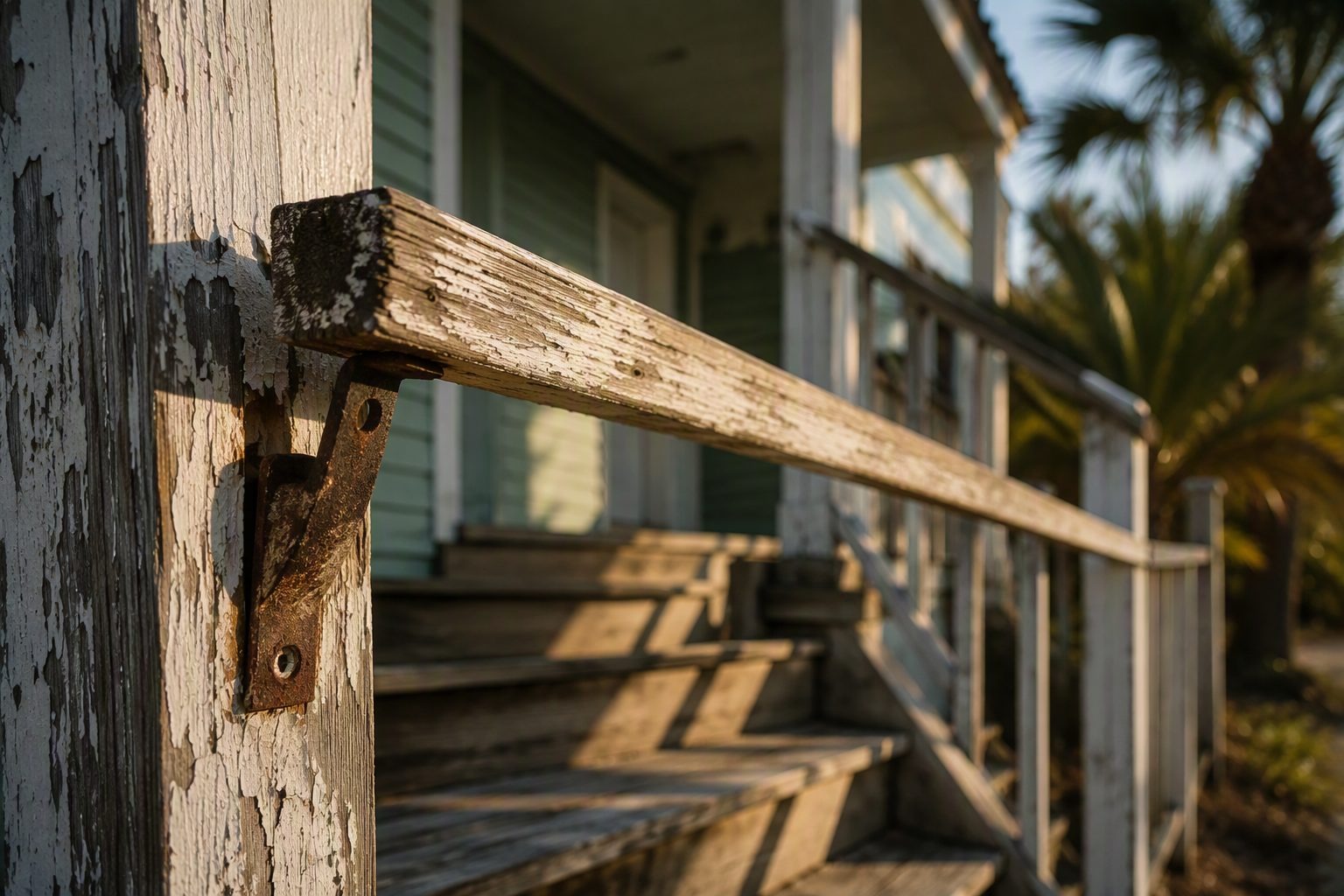
A guest grabs a loose stair rail on an exterior stairway, and the rail gives way. The same afternoon, a visitor trips over a box stacked inside a tenant's living room. Both injuries happened at rental properties, yet the two claims would start with very different questions: who controlled the space, and who knew about the hazard.
The main South Carolina premises liability factors are control, notice, legal duty, location, and causation. Those factors decide whether a rental-property injury claim points to a landlord, a tenant, a property manager, a contractor, or several parties at once.
At a South Carolina rental property, liability usually lands on the person or business that controlled the hazardous area and either created the danger or had actual or constructive notice of it but failed to respond reasonably. Depending on the lease, location, repair history, and cause, any of those parties could be liable.
This article offers general information, not legal advice. Responsibility in a specific case rests on the evidence, the applicable law, the insurance terms, and the relationships among the parties.
Which South Carolina Premises Liability Factors Determine Responsibility?
The central questions are who controlled the location, what duty that party owed, whether the party created or knew of the hazard, whether the response was reasonable, and whether the condition caused the injury. The evidence informs each answer.
What Elements Make Up a South Carolina Premises Liability Claim?
The elements of a South Carolina premises liability claim are a legal duty, breach of that duty, injury or compensable loss, and proximate causation. In a property case, control of the area, the visitor's legal status, and actual or constructive notice help determine whether a duty existed and whether the defendant breached it.
A premises liability claim in South Carolina starts with ordinary negligence principles. Under Larimore v. Carolina Power & Light, 340 S.C. 438, 531 S.E.2d 535 (Ct. App. 2000), South Carolina common law negligence generally requires a claimant to establish a duty recognized by law, a breach of that duty, an injury or compensable loss, and proximate causation connecting the breach to the injury. Premises cases add location-specific questions, because the injured person's legal status, the defendant's control of the area, and notice of the dangerous condition can shape both duty and breach, as the Court of Appeals explained in Singleton v. Sherer, 377 S.C. 185, 659 S.E.2d 196 (Ct. App. 2008).
Actual notice means the responsible party received a complaint, observed the defect, or otherwise knew about it. Constructive notice signifies the condition existed long enough, recurred predictably, or was apparent enough that reasonable inspection or maintenance should have caught it. A recurring puddle near a known leak presents very different facts from a first-time spill minutes before a fall.
Control matters. Ownership alone does not resolve liability, and courts may examine possession, retained control, repair authority, contractual responsibilities, and the party's actual conduct before assigning responsibility. See Miller v. City of Camden, 329 S.C. 310, 494 S.E.2d 813 (1997).
Notice often shapes these claims, and injured renters and their guests may need help distinguishing landlord duty from tenant fault. The statute sets repair obligations, but whether a landlord actually knew, or should have known, about the broken rail or the dead walkway light is a factual fight over work orders, complaints, and inspection logs. That is the core of the premises liability factors to watch out for in SC.
How Do State Law and the Lease Divide Repair Responsibilities?
A lease can assign duties to both landlord and tenant, but it cannot erase rights or responsibilities imposed by South Carolina law.
The South Carolina Residential Landlord and Tenant Act supplies the baseline for residential rentals. Under S.C. Code Ann. § 27-40-440, a residential landlord generally must comply with building and housing codes materially affecting health and safety, make necessary repairs and keep the premises fit and habitable, keep common areas reasonably safe, and keep specified facilities and systems in good working order. The section also governs when landlords and tenants may agree that the tenant will undertake specified repairs or maintenance. Such an agreement does not release the landlord from responsibility.
Tenants carry duties too. S.C. Code Ann. § 27-40-510 requires a tenant to keep the occupied area reasonably clean and safe, use facilities reasonably, and avoid deliberately or negligently damaging the property. A tenant who creates a dangerous condition may bear responsibility to an injured guest. The landlord can still reenter the analysis if a structural defect, retained repair duty, prior notice, or negligently completed repair contributed to the accident.
Lease language has limits. S.C. Code Ann. § 27-40-330 generally bars a rental agreement from requiring a tenant to waive statutory rights or agree in advance to indemnify the landlord for liability imposed by law. Not every indemnity or maintenance clause is invalid, and the language, context, and governing law require individual review.
Notice and repair timing often decide these disputes. A delayed work order following a written complaint can establish when the condition was reported and how the responsible party responded.
Who May Be Responsible in Four Common Rental-Property Scenarios?
The scenarios below illustrate questions to investigate, not predetermined outcomes.
What Are Common Rental Premises Liability Case Examples?
Common premises liability case examples include falls caused by loose stair rails, unlit walkways, hazards inside tenant-controlled rooms, and defects in shared parking lots. Each example depends on who controlled the area, who created or knew about the condition, and whether that condition caused the injury.
Scenario | Likely Control Question | Evidence That Could Affect Responsibility
|
|---|---|---|
Loose stair rail | Was the stairway inside the unit or retained as a common area? | Inspection reports, repair requests, prior complaints, photographs, and contractor records |
Unlit walkway | Who maintained the lighting and surrounding common area? | Outage duration, bulb or fixture history, electrical reports, and notice records |
Tenant-controlled living area | Did the tenant create the hazard, or was it a structural defect? | Move-in inspection, lease terms, photographs, and communications |
Shared parking lot | Did the owner, manager, association, or contractor control maintenance? | Management agreements, vendor contracts, pavement inspections, and lighting records |
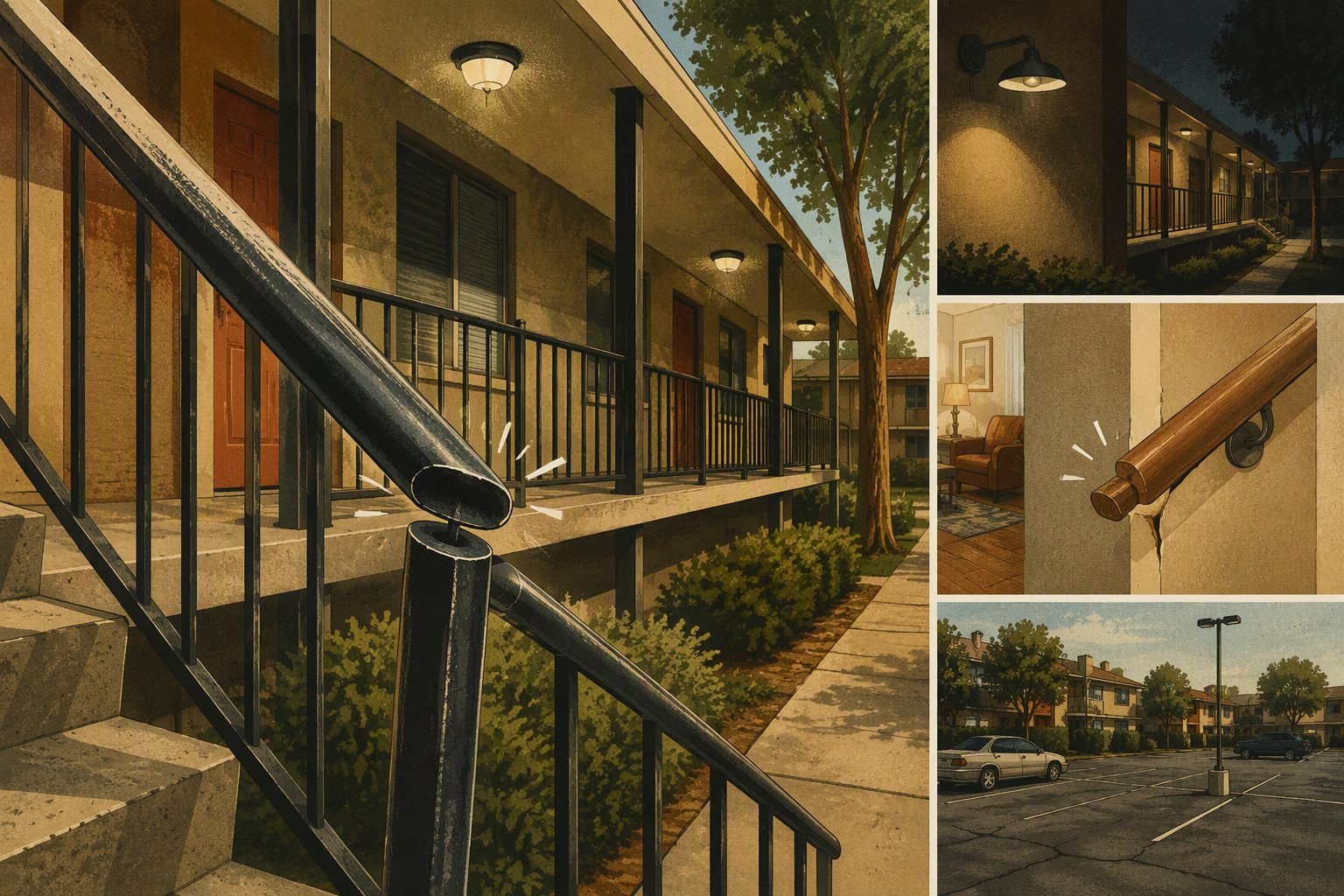 Inspection and repair records tied to the exact location often shape the responsibility analysis.
A Loose Stair Rail
A landlord is more likely to face responsibility for a loose rail in a retained common stairway when the landlord created the defect, received notice, or should reasonably have discovered it before the fall.
A rail inside a tenant-controlled unit raises other questions: whether the defect was structural, whether the tenant reported it, whether the landlord had access and repair authority, and whether a reasonable repair period had passed. A code violation alone does not make a landlord liable. Any negligence per se theory should be evaluated under Watson v. Sellers, 299 S.C. 426, 385 S.E.2d 369 (Ct. App. 1989), and other current South Carolina authority.
An Unlit Walkway
Responsibility for an unlit walkway generally turns on control of the lighting, the length of the outage, prior reports, inspection practices, and whether the lack of light contributed to the fall.
In Davenport v. Cotton Hope Plantation Horizontal Property Regime, 333 S.C. 71, 508 S.E.2d 565 (1998), the South Carolina Supreme Court explained that a person's knowledge of an obvious risk does not necessarily end the case. Comparative negligence principles may instead require allocating fault based on the evidence, so an open and obvious condition cannot be treated as an automatic defense.
A Hazard Inside a Tenant-Controlled Living Area
A tenant may be primarily responsible when they create a temporary hazard inside an area under their exclusive control: clutter, a spill, an unsecured personal item.
Other facts can bring the landlord back into the analysis. A concealed structural defect, a known electrical problem, a promised but negligently completed repair, or a condition the landlord had a statutory duty to address can change the analysis.
A Defect in a Shared Parking Lot
A shared parking-lot claim often focuses on which party controlled inspection, lighting, paving, drainage, and repairs at the time of the incident.
Ownership, a property management agreement, an owners' association arrangement, or a maintenance contract may distribute those responsibilities. Involvement with the property does not, by itself, make a manager or contractor liable. The analysis should focus on the party's precise responsibilities and conduct.
What Exceptions Can Change the Liability Analysis?
Even when a landlord controlled the area and knew about a defect, causation, comparative negligence, visitor status, statutory exclusions, and another party's conduct can change or reduce responsibility.
Visibility matters but rarely settles the question. South Carolina decisions addressing open and obvious hazards, including Callander v. Charleston Doughnut Corp., 305 S.C. 123, 406 S.E.2d 361 (1991), and Davenport, treat awareness of a condition as important evidence rather than an automatic defense.
South Carolina follows modified comparative negligence. Under Nelson v. Concrete Supply Co., 303 S.C. 243, 399 S.E.2d 783 (1991), a plaintiff may generally recover when the plaintiff's negligence is not greater than the defendant's, with damages reduced according to the plaintiff's share of fault.
The statutory framework has boundaries. S.C. Code Ann. § 27-40-120 identifies arrangements excluded from the Residential Landlord and Tenant Act, including transient occupancy and specified institutional, employee, and condominium-owner occupancy. The governing rules therefore turn in part on the type of property and occupancy.
Causation can also defeat a claim. An injury occurring on the property does not itself prove that a dangerous condition caused it. Medical records, witness accounts, video, footwear, weather, and later alterations may all affect the result.
What Records Should an Owner Preserve After a Reported Injury?
Preserve records immediately, keep original files intact, notify the appropriate insurer, and document temporary safety measures without speculating about fault or altering evidence.
The incident report, including the reported time, precise location, conditions, and names of witnesses
Time-stamped photographs and video of the area, plus relevant surveillance footage before automatic deletion
The signed lease, amendments, move-in inspection, rules, and maintenance allocations
Complaints, emails, texts, portal messages, work orders, inspection logs, and repair invoices
Lighting, paving, stair, railing, plumbing, or electrical service records tied to the location
Property management agreements, association documents, and vendor contracts defining who maintained the area
Insurance policies, certificates, claim notices, and communications with the carrier
Records of temporary warnings, barricades, emergency repairs, and later permanent repairs
Preserve evidence without editing metadata or discarding unfavorable material. Do not delay repairs needed to prevent another injury merely to preserve the scene; document the original condition first when safely possible.
Do not include admissions, blame, or promises of payment in an incident report. Record observable facts and the exact words used by witnesses. If water contributed to the incident, take reasonable steps to prevent further damage while preserving photographs, video, and maintenance records.
Frequently Asked Questions About South Carolina Rental-Property Claims
Why Can a South Carolina Premises Claim Be Difficult to Prove?
These claims are hard because the injured person must prove duty, breach, causation, and damages while connecting the defendant to the location through control or another recognized legal responsibility. Those requirements come from South Carolina negligence and premises-liability decisions, including Larimore and Singleton.
Missing surveillance footage, disputed notice, unclear repair duties, and competing accounts all make proof harder. Complete records can establish when the condition arose, who knew about it, and how each party responded.
What Does Premises Liability Insurance Coverage Mean?
Premises liability coverage generally means insurance protection for covered claims alleging that an unsafe condition on property caused bodily injury or property damage. Whether a particular incident is covered depends on the policy language, exclusions, limits, deductibles, endorsements, and facts of the claim.
How Does Premises Liability Coverage Differ From General Liability Coverage?
Premises liability coverage focuses on claims arising from conditions or activities at property connected to the insured, while general liability coverage is a broader category that may include premises-related claims along with other covered operations and liabilities. The distinction depends on the policy because “premises liability coverage” is not necessarily a separate, standardized insurance product.
Turn the Evidence Into a Clear Response Plan
Owners and managers can respond by securing the scene, preserving relevant records, reporting the incident to the appropriate insurer, and addressing any continuing danger. Read lease language alongside the South Carolina Residential Landlord and Tenant Act and the parties' actual control of the area, because a lease cannot override governing law.
When the injury is serious, responsibility is disputed, or several parties maintained the property, a South Carolina attorney and the applicable insurance carrier can evaluate the evidence under current law and policy terms.





