




In real estate, income is often irregular, and expenses can creep in fast. One good month can create a false sense of security, and one slow month can undo it just as quickly.
So, the agents who actually grow and stay in the game aren’t the ones relying on a single tactic that “works.” They’re the ones operating within a system.
A system where:
· opportunities are generated intentionally
· money is managed with discipline
· decisions are guided by data (not gut feeling)
· and every part of the business—marketing, partnerships, accounting, reinvestment—works together
That doesn’t mean individual tactics don’t matter. They do. But it’s the way they connect that turns occasional wins into predictable results.
That’s exactly what we’ll break down next. Not isolated tips, but financial strategies that work together to create growth.
1.Working with an Accounting Firm That Enforces Structure
Most new agents treat accounting as something to “set up later.” In reality, that delay is exactly what creates financial chaos early on.
What consistently works instead is working with an accounting firm that uses a rigorous vetting process from the start. Particularly, in terms of:
· separating personal and business finances
· clearly defining income streams
· categorizing expenses properly
· setting up systems that track real profitability
This matters because many small business owners operate without clear visibility into their numbers, which leads to reactive decisions like spending without knowing what’s working or realizing too late where money is leaking.
Rigorous vetting processes remove that ambiguity. They introduce discipline before bad habits form and create immediate financial clarity.
2.Income Pipeline Structuring
Real estate businesses that rely on random closings stay volatile. Those that build structured pipelines gain something far more valuable, and that's predictability.
To explain, in practice, a pipeline shouldn't just be a list of leads. A pipeline is a system that tracks:
· where every potential deal sits
· how likely it is to close
· when revenue is expected
That’s why the industry itself increasingly defines strong performance not by lead volume, but by pipeline quality.
And the data makes it clear why this matters:
Up to 80% of deals require multiple follow-ups, yet nearly half of agents stop after the first contact. At the same time, leads contacted within minutes are dramatically more likely to convert than those followed up hours or days later.
In a market where deals take 30, 60, sometimes 90+ days to close, this becomes even more critical. Some clients convert quickly. Others take months. Without separating short-term, mid-term, and long-term opportunities, agents end up relying on timing and luck instead of flow.
3.Strict Expense-to-Income Discipline Early On
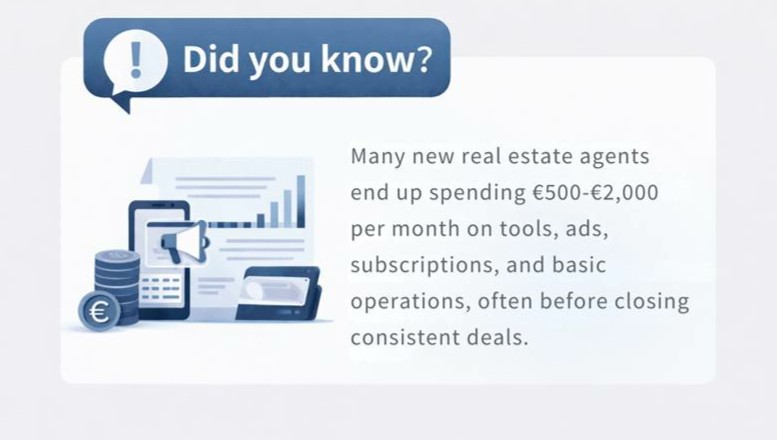
Up to 87% of agents exit the industry within their first few years, and one of the most common reasons is the inability to sustain irregular income early on.
It's easy to imagine why that happens: agents have tons of front-load costs. Branding, ads, tools, subscriptions, etc.—so they’re effectively betting on revenue that hasn’t materialized yet.
And when that revenue is delayed (which it often is), the pressure builds fast.
What consistently works instead is aligning expenses with validation.
Not "spend and hope it works," but "close, then scale."
Agents who grow sustainably tend to keep fixed costs low in the early phase, relying on lower-cost acquisition channels until they close their first deals. Only then do they start increasing spend—because at that point, they’re not guessing what works; they’re reinforcing it.
4.Commission Management and Cash Flow Buffering
We've already established that real estate income is uneven by nature, but financial instability isn’t inevitable. In fact, it’s often a result of how commissions are handled.
New agents tend to treat each commission as fully available income. Proven agents, however, structure it.
Instead of spending what comes in, they allocate:
· a portion for taxes
· a portion for business reinvestment
· a portion for personal income
· and a portion into a cash buffer (typically 3–6 months)
This isn’t about being conservative. It’s about smoothing out an inherently unpredictable income stream.
5.Reinvestment Strategy Based on ROI
New agents often reinvest based on trends or what others are doing—posting everywhere, trying every channel, and spreading budget thin.
What consistently works instead is much simpler: track what actually leads to closed deals, and reinvest only there.
In real estate, not all marketing activities perform equally:
· High-intent channels like referrals, local SEO, repeat clients, and partnerships tend to convert better because trust is already present.
· Lower-intent channels like broad social media reach or content without a clear funnel can build visibility but rarely translate into deals.
The mistake is treating all exposure as equal.
If referrals bring 3 deals and Instagram brings none, the answer isn’t “post more” but invest deeper into referral systems.