



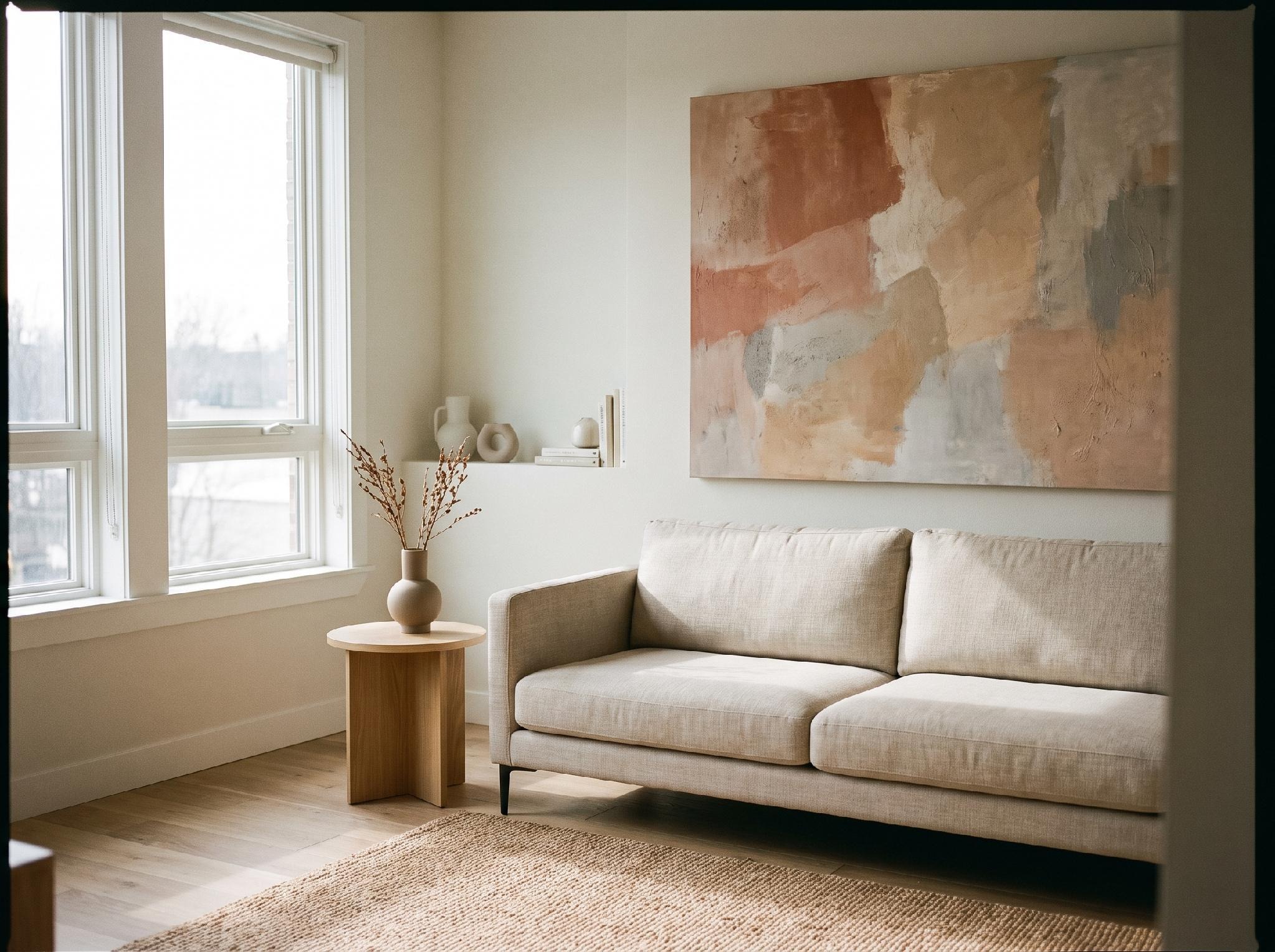
More than 104 million Americans now live in rental housing. That’s 34.9% of U.S. households as of the latest Census data, up from 33.5% a decade ago, according to iPropertyManagement’s 2026 renting statistics. Renting isn’t a stopgap anymore. It’s how a huge share of the country lives, and increasingly, people want their rental to feel like a home rather than a waiting room.
The problem is walls. Renters want their living room to feel finished, personal, and a little dramatic. But they’re also terrified of drilling the wrong hole and watching it come out of their security deposit. That fear pushes a lot of people toward decorating with nothing but removable clips and washi tape, which looks exactly as flimsy as it sounds.
There’s a better move, and it’s simpler than most rental decor advice admits.
Why One Big Piece Beats a Gallery Wall in a Rental
A single oversized piece of art does more for a living room than eight small frames scattered across the same wall, and it does it with a fraction of the risk. Instead of a dozen nail holes spread across a gallery arrangement, you’re dealing with one or two hanging points for a piece that reads as intentional the second you walk in the door.
This isn’t just a style preference. A June 2026 Houzz survey found that 68% of homeowners and renters under 40 now prioritize furniture and decor that “solves more than one problem” rather than collecting a pile of small accents, part of a broader shift toward what the survey calls warm minimalism. A big canvas is exactly that kind of dual-purpose choice: it’s the focal point and the personality of the room in a single object. When you’re ready to shop for something scaled to an actual living room wall, big wall art for living room options give you pieces sized to fill that space properly instead of looking like an afterthought.
Gallery walls aren’t bad. They just ask a lot of a rental wall that a landlord will eventually inspect. One statement piece asks for almost nothing in comparison.
Sizing Your Statement Piece to the Room
Scale is where most renters get nervous and end up buying too small. A piece of art that’s too modest for its wall reads as an accident, not a decision, no matter how nice the piece itself is.
The general rule design writers land on again and again: your art should cover roughly two-thirds of the width of the furniture it hangs above. Over a standard sofa, that usually means a canvas somewhere in the 40 to 60 inch range, not the 16x20 print you’d hang in a hallway. Measure the wall and the furniture below it before you buy anything. Painter’s tape on the wall, cut to the dimensions you’re considering, will save you from a piece that looks stranded in too much blank space.
Proportion matters more than price here. A modestly priced piece that’s correctly scaled will always outperform an expensive piece that’s too small for its wall.
Hanging Big Art Without Losing Your Deposit
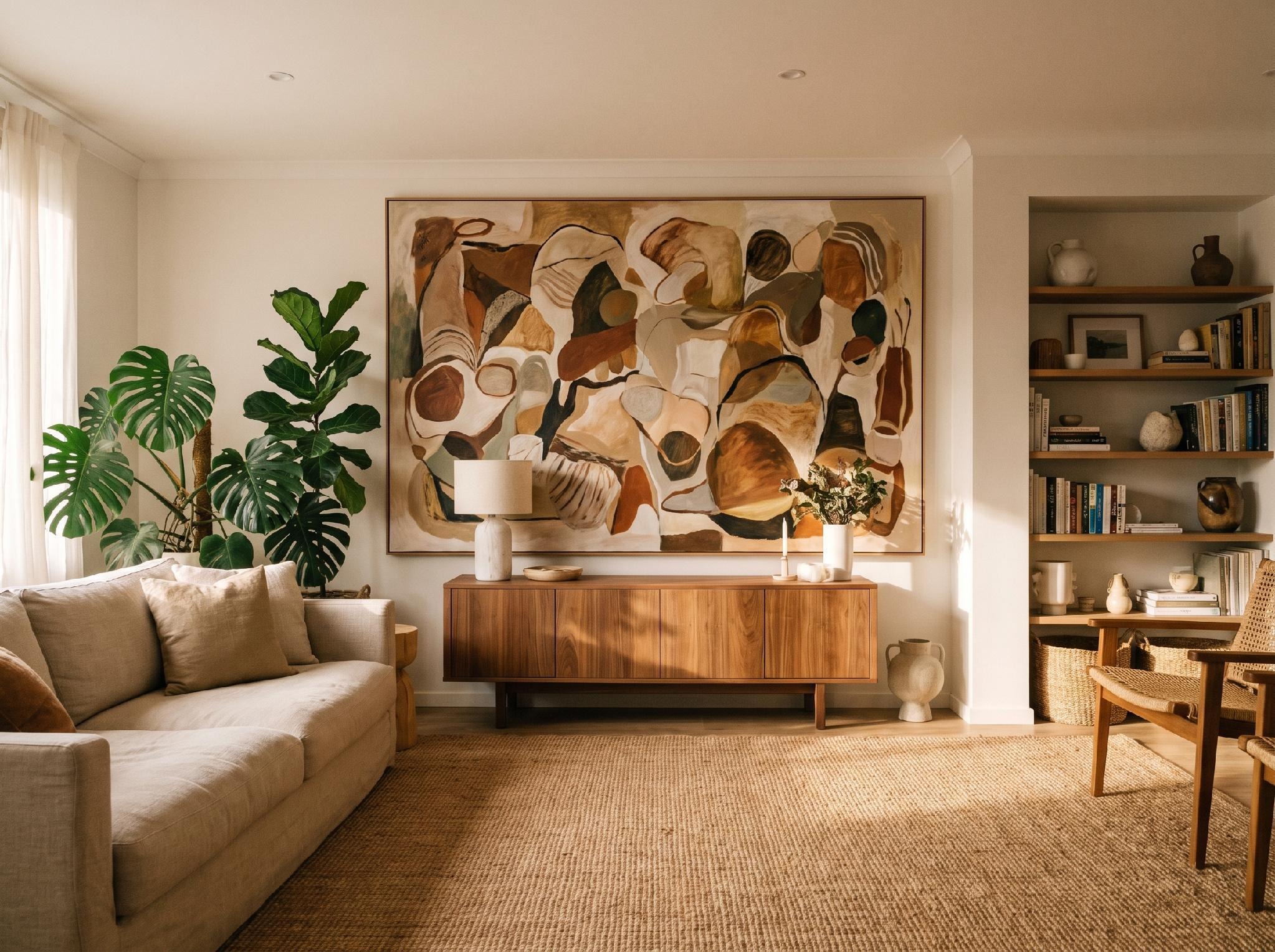
Here’s the part most rental decor guides skip entirely: the actual legal exposure. Landlords can’t deduct a security deposit for damage that counts as normal wear and tear, and small nail holes almost always fall into that category. Legal research compiled by iPropertyManagement across multiple states confirms that two to four small nail holes per wall are near-universally treated as normal wear and tear, not chargeable damage. A dense gallery wall with fifteen or twenty holes is a different story, and that’s exactly where renters run into trouble.
One large piece typically needs one or two hanging points, whether you use a sturdy picture hook rated for the weight or a heavy-duty removable strip designed for canvases. That keeps you comfortably inside the range landlords and courts recognize as normal use. It’s worth a quick check of your lease before you hang anything, since some buildings do specify picture-hanging rules, but for the vast majority of renters this is a low-risk decision. If you want more ideas for making a space feel like yours within those boundaries, this guide to personalizing a rental without losing your deposit covers plenty of other low-commitment upgrades.
Skip the drywall anchors unless you’ve confirmed with your landlord. A single properly placed nail is nearly always the safer, simpler choice.
Budgeting for a Statement Piece
Renters are already spending money on decor that doesn’t outlast the lease. Apartment List’s national rent report puts the median monthly rent at $1,388 as of July 2026, the sixth straight monthly increase even with rents still running slightly below year-ago levels. With that much going to rent every month, it makes sense that people are cautious about sinking more money into upgrades that vanish the moment they move.
That caution hasn’t stopped renters from spending, though. Forbes reported that Yelp’s 2026 summer trends data shows wallpaper project requests up 450% and window-treatment searches up 34%, a clear signal that renters are investing in upgrades that travel with them or peel off cleanly. A single large piece of art fits that same logic. It’s one purchase instead of a dozen small ones, it moves to your next apartment without a scratch, and it doesn’t require touching up paint before you hand back the keys. For more ways to stretch a decorating budget without permanent changes, this rundown on making a rental feel more luxurious on a budget is worth a look.
Think of it as a one-time investment that replaces a dozen smaller ones, not an added expense on top of them.
Pairing Big Art With the Rest of the Room
A statement piece works best when the rest of the room supports it rather than competes with it. Once the art is up, look at what’s soft in the space. Rugs, throw pillows, and curtains do more to tie a room together than most renters give them credit for, and none of them require a single hole in the wall.
Curtains, in particular, are worth getting right, since they frame the same sightline as your art and can either complement it or clash with it, depending on color and texture. If you rent, buying curtains you actually love and can take with you between apartments means you’re not starting from scratch every time you move. Between the art on the wall and soft textiles doing the rest of the work, a living room can look considered rather than half-finished, even on a renter’s timeline.
Keep the palette simple. One bold piece of art plus a couple of coordinating textile colors reads as curated. Five competing patterns read as chaos.
Conclusion
Renting doesn’t mean living with bare walls or settling for a scattershot of tiny frames held up with tape. One well-chosen, properly sized piece of statement art does more for a living room than almost any other single decorating decision, and it carries a fraction of the deposit risk that a gallery wall does.
Measure your wall, pick a piece that actually fills it, hang it with one or two secure points, and you’ve solved the room. Best of all, it packs up in an afternoon and goes with you to the next place, no patching required beyond a couple of small holes nobody will ever notice.