



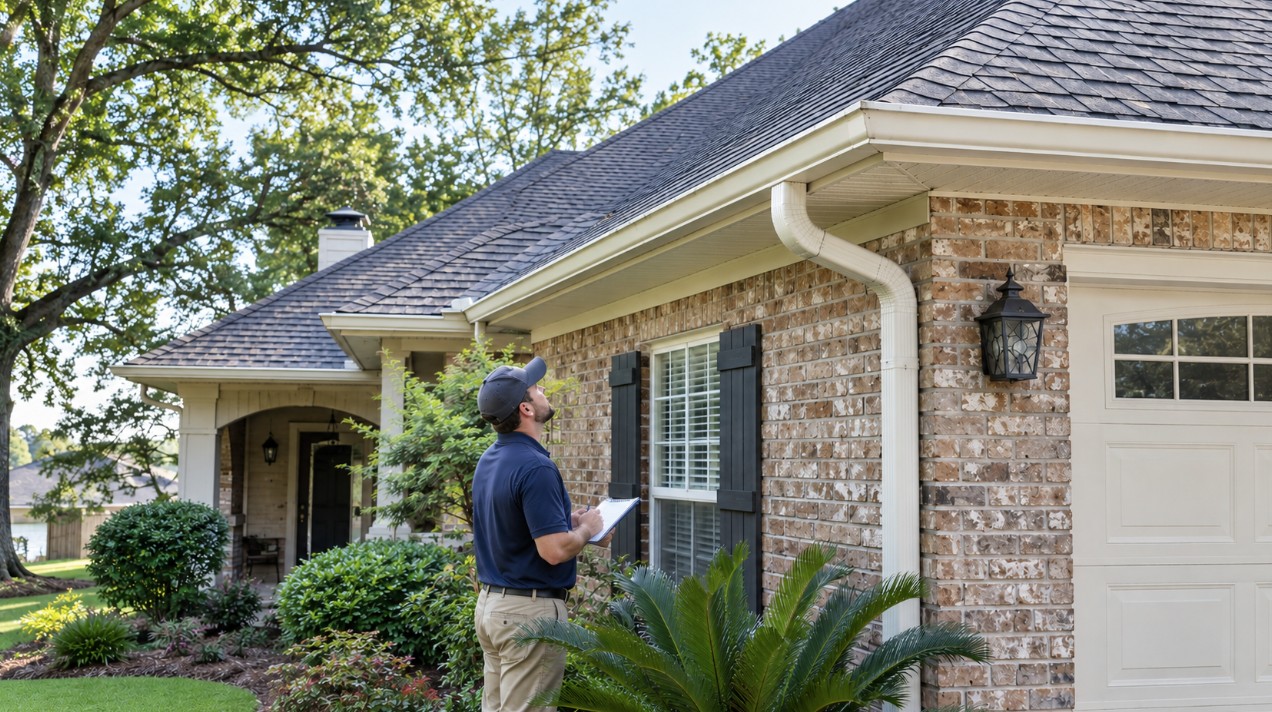
Most maintenance checklists are organized by month, which makes them easy to write and easy to ignore. A more useful way to think about the outside of a Baton Rouge house is by component, because each one has its own failure mode and its own natural inspection rhythm.
The context for all of it is that this is a wet climate with very little dry-out time. NOAA's 1991 to 2020 normals put annual precipitation at Baton Rouge Ryan Airport at 61.94 inches, with an August average overnight low of 73.3 degrees. Things here stay damp. Work through the list below once or twice a year and you will catch nearly everything that matters.
The roof surface
Twice a year, and always after a wind event, look at your roof from the ground with binoculars. You are checking for tabs that have lifted and not resealed, exposed nail heads, displaced ridge cap, and any slope that looks visually uneven.
Then check the gutters for granules. Asphalt shingles shed some granules throughout their life, but a sudden accumulation after a hailstorm means the mat underneath took impact. Dark patches on the roof surface where the granule coverage has thinned indicate the same thing from a distance.
Dark vertical streaks are algae. They are cosmetic in the near term but they mark slopes that stay wet, which is the same condition that shortens shingle life. Clean them with a manufacturer-approved solution applied at low pressure. Pressure washing a shingle roof removes granules and voids most warranties.
Flashing and penetrations
This is where leaks start, so it deserves a dedicated look rather than a glance. Plumbing vent boots are the usual culprit. The rubber collar around the pipe degrades under UV, cracks, and lets water run straight down the pipe into the ceiling below. On a roof over ten years old, assume the boots need attention.
Check the flashing at the chimney, at any skylight, and at every point where a roof slope meets a wall. Look for caulk doing structural work. Caulk is a supplement to properly lapped metal, not a substitute for it, and a bead of sealant along a flashing edge is usually a sign someone took a shortcut.
Fascia, soffit, and trim
Walk the perimeter and look up. Soft or discolored fascia means water has been getting behind the gutter, typically at a failed joint or a spot where the drip edge is too short. Press on suspect areas with a screwdriver. Wood that gives is wood that is already rotting.
Vinyl or aluminum soffit panels should be locked into their channels along both edges. Panels that rattle or sag will blow out in tropical winds, and an open soffit lets wind pressurize the attic from below.
Around Baton Rouge, damp fascia and soffit wood is also a Formosan termite entry point. The LSU AgCenter publishes swarm guidance each spring, and swarming runs through the April and May evenings. Discarded wings on a porch or windowsill are worth following up on.
Gutters and drainage
Clean them in late winter after the oaks have finished dropping, and again in late fall. Do not just remove debris, run water through and watch it move. Slow drainage means a downspout clog or a section that has lost pitch.
Check the hangers. Gutter spikes back out of the fascia over years of wet and dry cycling, and a run held by three loose spikes will fold under the weight of a heavy rain. Hidden hangers screwed into solid fascia are a durable upgrade and the ideal moment to install them is during a roof replacement, when the baton rouge roofing contractors working on your house have the gutters down anyway.
Follow the water past the downspout. It should be discharging at least eight feet from the slab onto ground that slopes away.
The attic
Twice a year, with a flashlight, and it is the step almost everyone skips.
Look at the wood, not the insulation. Dark staining on the sheathing, frost or beads on nail tips after a cold front, and daylight visible through the deck are all things you want to find early. Check above the bathroom fans, because a fan terminating in the attic instead of through the roof delivers a shower's worth of steam up there daily.
Feel the AC ducts on a summer day. Damp ductwork means failing insulation, and that condensation lands on your ceiling drywall and looks exactly like a roof leak.
Confirm that insulation has not drifted over the soffit vents. If it has, the ridge vent has nothing to pull from and the attic is not ventilating regardless of how it was designed.
Grade and foundation
South Louisiana clay shrinks in dry weather and swells when it rehydrates, and over a few years the soil next to your slab can pull away and form a trough. Ground should fall roughly six inches over the first ten feet from the wall. Reestablishing that slope with a few loads of soil is inexpensive and it keeps roof runoff from collecting where you least want it.
Your paperwork
Worth adding to the list since the rules changed. Act 239 of the 2025 regular session, effective August 1, 2025, requires permitting and inspection for roof construction and reroofing statewide. If you have work done, keep the permit and the inspection record with your closing documents. It is your evidence at resale and in any future claim that the work met code.





