



Picture a snow-dusted post-and-beam cottage tucked among spruces, its timber rafters glowing in the late-afternoon sky. That scene isn’t just a postcard; it’s a promise of a home ready for Maine’s bold climate.
Timber-frame construction shines here for two big reasons. First, heavy posts and precision joinery shrug off blizzards and nor’easters far better than flimsy stick framing, giving you fewer midnight worries when the wind howls. Second, Maine’s 2021 energy code pushes every new build toward thicker insulation and tighter shells. Modern timber designs leave room for eight-inch SIPs, so you stay toasty without sky-high heating bills.
We teamed up with Hamill Creek Timber Homes—one of the leading timber-frame builders serving Maine—to curate five standout plans that marry resilience, efficiency, and timeless New England style. Over the next few minutes, you’ll see why each design earns its spot, how it fits real Maine lifestyles, and what to watch for before breaking ground. Ready to meet your forever home?
Why timber-frame homes feel right at home in Maine
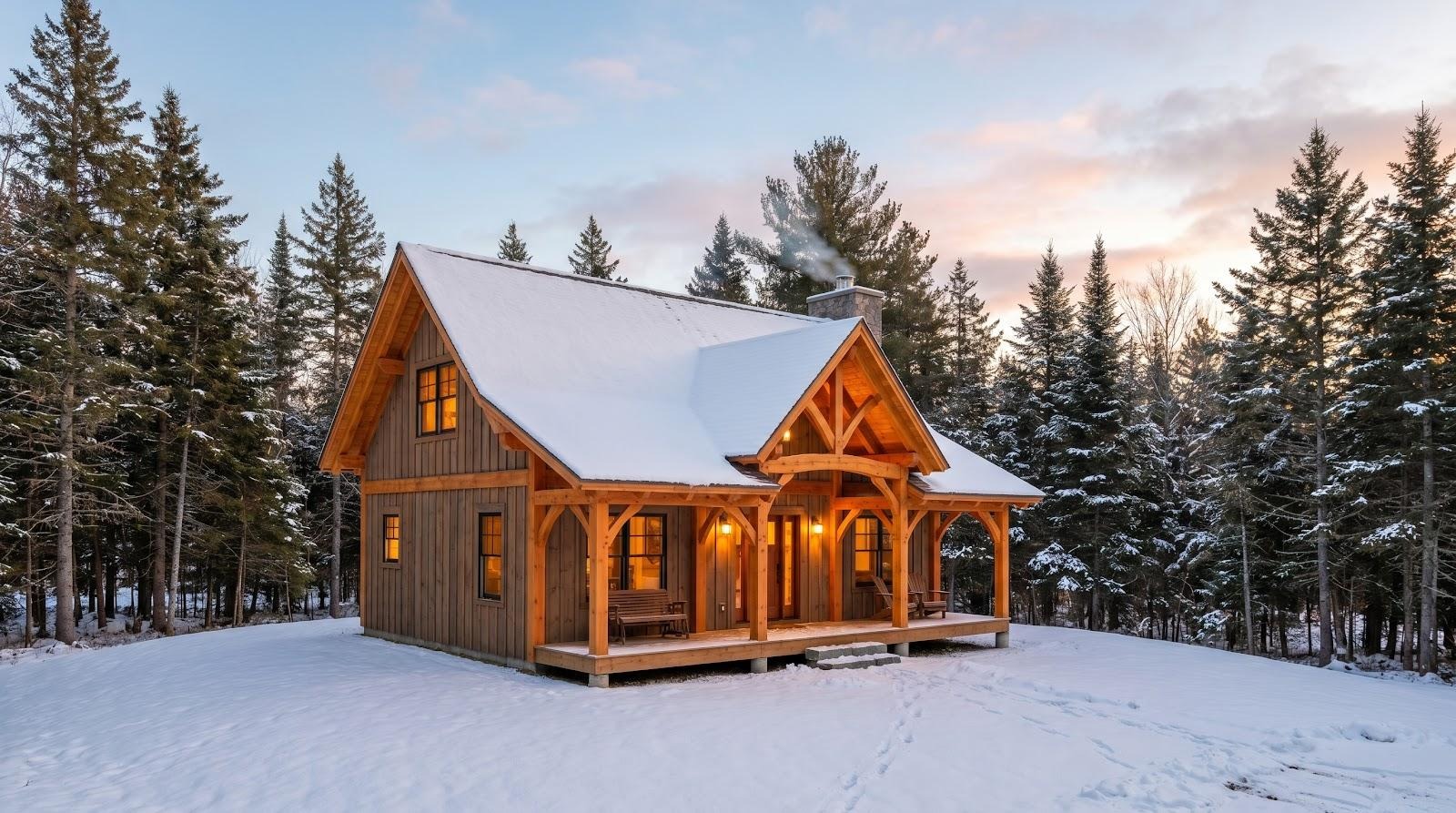
Maine dishes out weather with gusto: towering snowdrifts, sideways coastal rain, and the occasional nor’easter that rattles lesser walls. Heavy timber framing absorbs those hits and stays calm. Thick posts, tight mortise-and-tenon joints, and beefy roof trusses stand up to 60-pound-per-square-foot snow loads far better than skinny stick framing, which means fewer midnight worries when the forecast turns ugly. Seasoned Maine timber frame builders such as Hamill Creek Timber Homes pre-engineer every joint for those snow loads and test-fit the frame in their shop before shipping. That precision lets the shell fly together in just a few days, long before the next nor’easter barrels up the coast.
Hamill Creek Maine timber frame builders webpage screenshot
Weather is not the only hurdle. The 2021 state energy code drives every new build toward deeper insulation and airtight shells. Smart timber designs already leave room for eight-inch structural insulated panels (about R-26 walls and R-42 roofs), so you meet the rules without heroic upgrades.
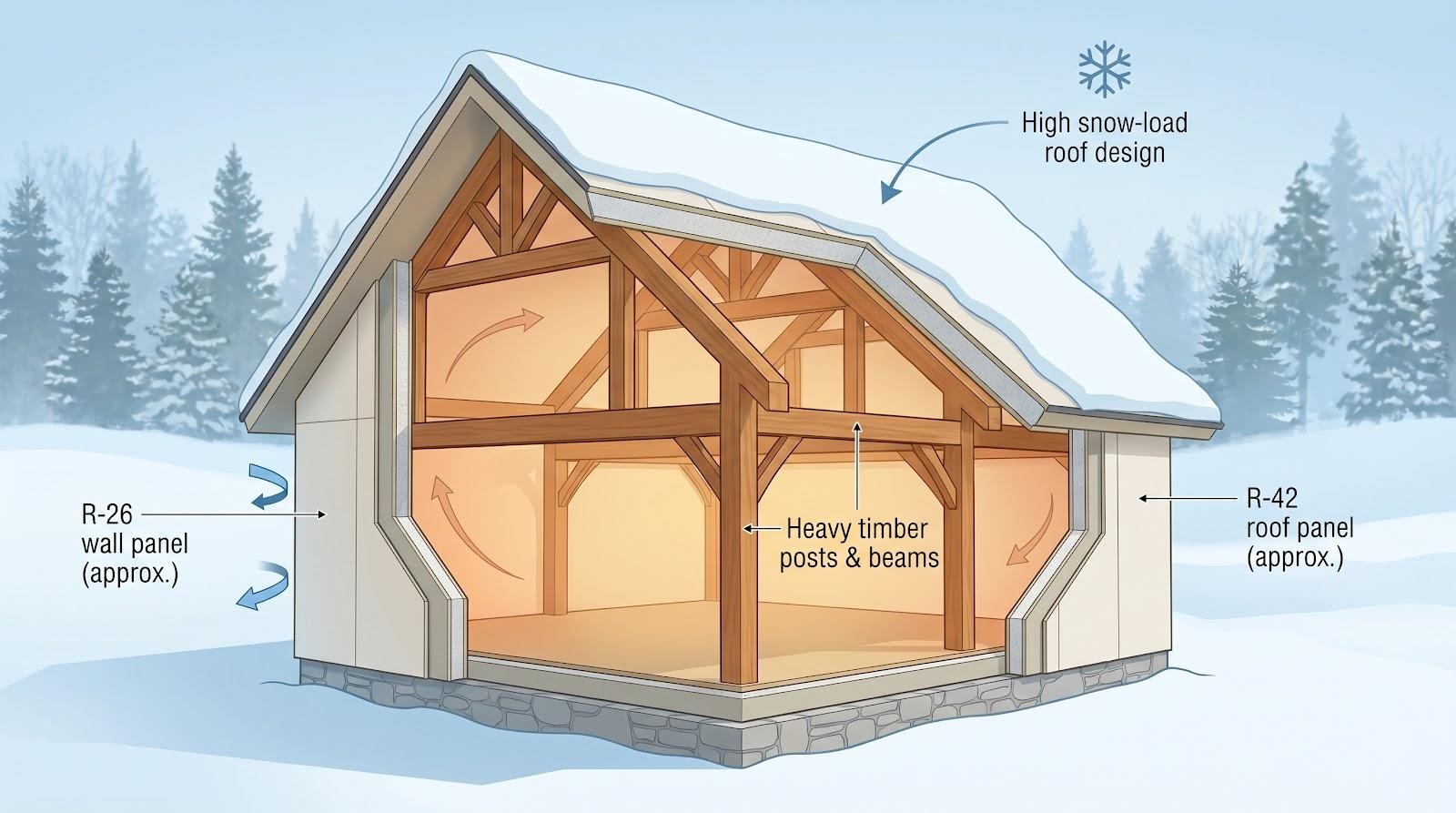
Wood’s natural insulating value adds another buffer, so you start each winter with a comfort head start. Fewer thermal bridges translate into more cozy nights and lower heating bills.
Style still matters. Exposed beams echo Maine’s historic barns and salt-box homes, giving your new house a familiar street presence. Inside, those same timbers unlock open floor plans fit for today’s living: great rooms, loft offices, and kitchens ready for weekend lobster feasts.
Put it together and the formula is simple: stronger bones, tighter shells, timeless looks. A timber frame is not just another way to build; it is the Maine way to build.
Clearwater: the expandable cottage built for Maine families
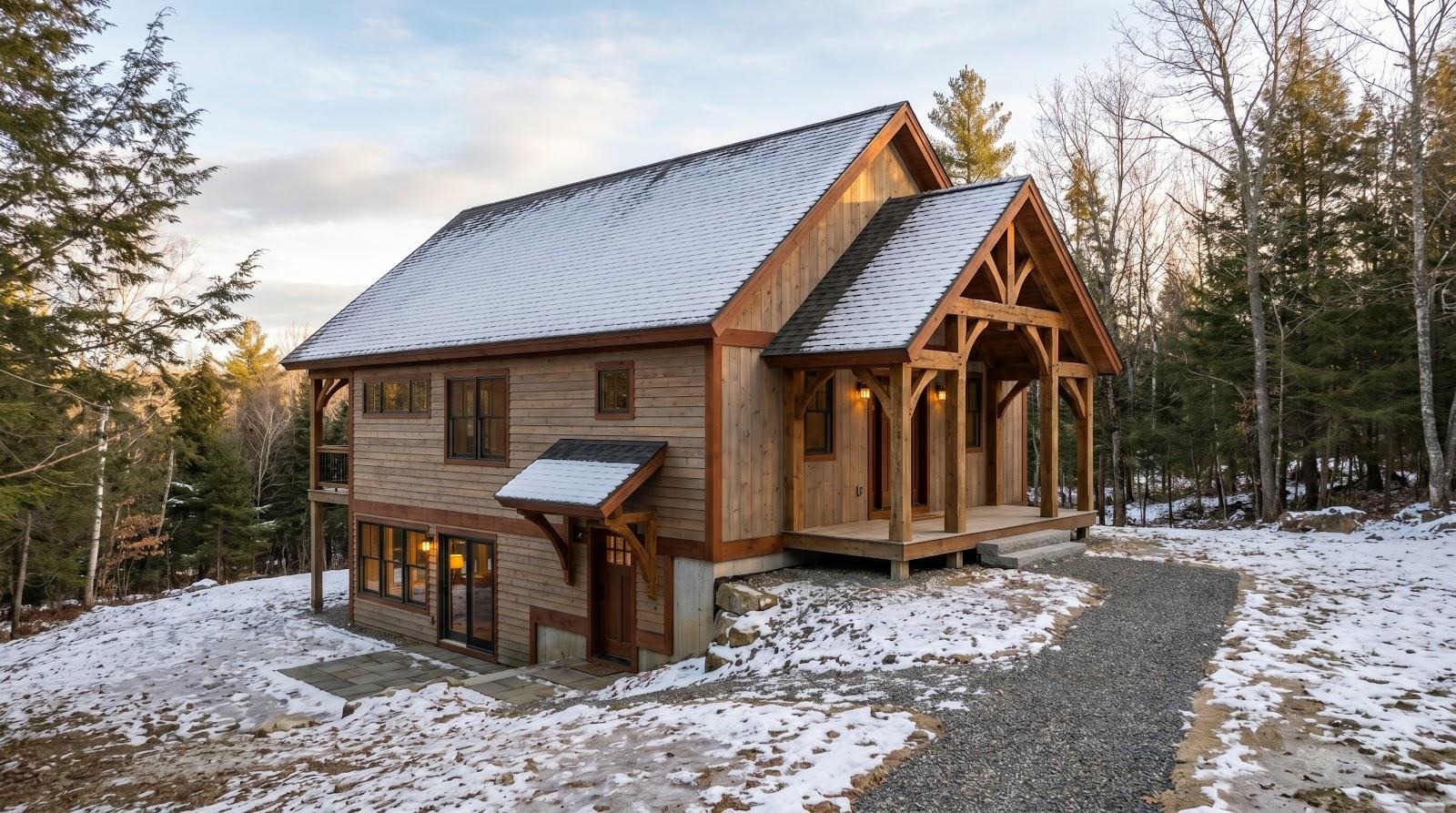
Clearwater looks modest at first glance, at just over 1,600 square feet of classic timber charm, yet step inside and you feel room to grow. Cathedral beams rise overhead, sunlight pours across open living and dining areas, and a sturdy hammer-beam porch welcomes you home in any weather.
Maine practicality shows up right away. A full mudroom corrals snowy boots and sandy flip-flops, while the steep gable roof sheds heavy drifts without fuss. Heavy posts and tight joinery give the frame the backbone to ride out nor’easters that send lighter builds scrambling.
Families appreciate options, and Clearwater offers plenty. Finish the walk-out basement when you need extra space and the plan jumps to five bedrooms without changing the footprint. Hosting holiday crowds, adding a home office, or giving teens their own hangout all fit with ease.
Heating costs stay sensible. The compact rectangle wraps cleanly in SIPs, locking in warmth and cutting drafts. At Maine’s typical $350–$500 per heated square foot for timber frames, Clearwater’s turnkey cost falls near $560,000–$810,000, with a finished basement adding more. For a future-proof family hub, that is solid value.
Bottom line: Clearwater delivers cozy living today and effortless expansion tomorrow. In a state where needs shift with the seasons, and the seasons never sit still, that flexibility is gold.
Sugarloaf: the cozy cabin that lives larger than its footprint
If Clearwater is the family workhorse, Sugarloaf is its carefree sibling, a 1,643-square-foot retreat tailor-made for ski weekends, lake escapes, or year-round downsizing.
Walk through the timber entry and the great room lifts in a single graceful vault. Beams soar, light streams through dormers, and a wraparound deck blends indoor fun with pine-scented air.
Space works hard. The main floor unites living, dining, and kitchen areas, while a tucked-away office doubles as a second bedroom. Upstairs, a loft lounge overlooks the fire below, perfect for movie night or extra bunks.
Energy bills stay low. The compact rectangle wraps cleanly in R-26 wall and R-42 roof panels, and fewer exterior corners mean fewer heat leaks. At Maine build rates, turnkey cost lands near $575,000–$820,000, leaving room in the budget for those custom maple cabinets you have been eyeing.
Practicality shows outside as well. A steep roof drops snow before it overstays its welcome, and the broad porch offers a dry spot to shed boots or sip iced tea during blackfly season.
Choose Sugarloaf when you crave simplicity without losing the drama of exposed timber. A smaller footprint still delivers big-lodge atmosphere, with no wasted square footage.
Green Ridge: refined timber living with a dash of luxury
Green Ridge greets you with a timber-arched window that pours Maine sunlight across a cathedral great room. It feels equal parts barn and boutique inn, pairing rugged beams with polished finishes.
Everyday life stays on one level. A generous primary suite sits behind the great room, and each half of the couple enjoys a private ensuite, so there is no queue for the shower or sharing closet space.
Guests relax in the optional walk-out basement, where two bedrooms each claim a private bath. Add an upstairs reading loft that looks down on the fire below and you have privacy plus togetherness in one smart package.
Porches wrap front and back, letting you chase sun or shade without stepping through slush. Large overhangs keep siding dry, while the tidy 1,899-square-foot shell is easy to seal with R-26 walls and R-42 roof panels. South-facing glass also pulls in free heat when the winter sky turns cobalt.
Expect to invest about $665,000–$950,000 turnkey in Maine, depending on finishes and whether you add the basement. That sits in the mid-upper custom market yet still beats many comparably lavish coastal builds.
Choose Green Ridge when you want heirloom craftsmanship without giving up modern comforts. It feels at home on a rocky peninsula, a lakeside lot, or an in-town parcel where thoughtful design earns appreciative glances.
Rocky Mountain: the grand lodge for gathering everyone under one roof
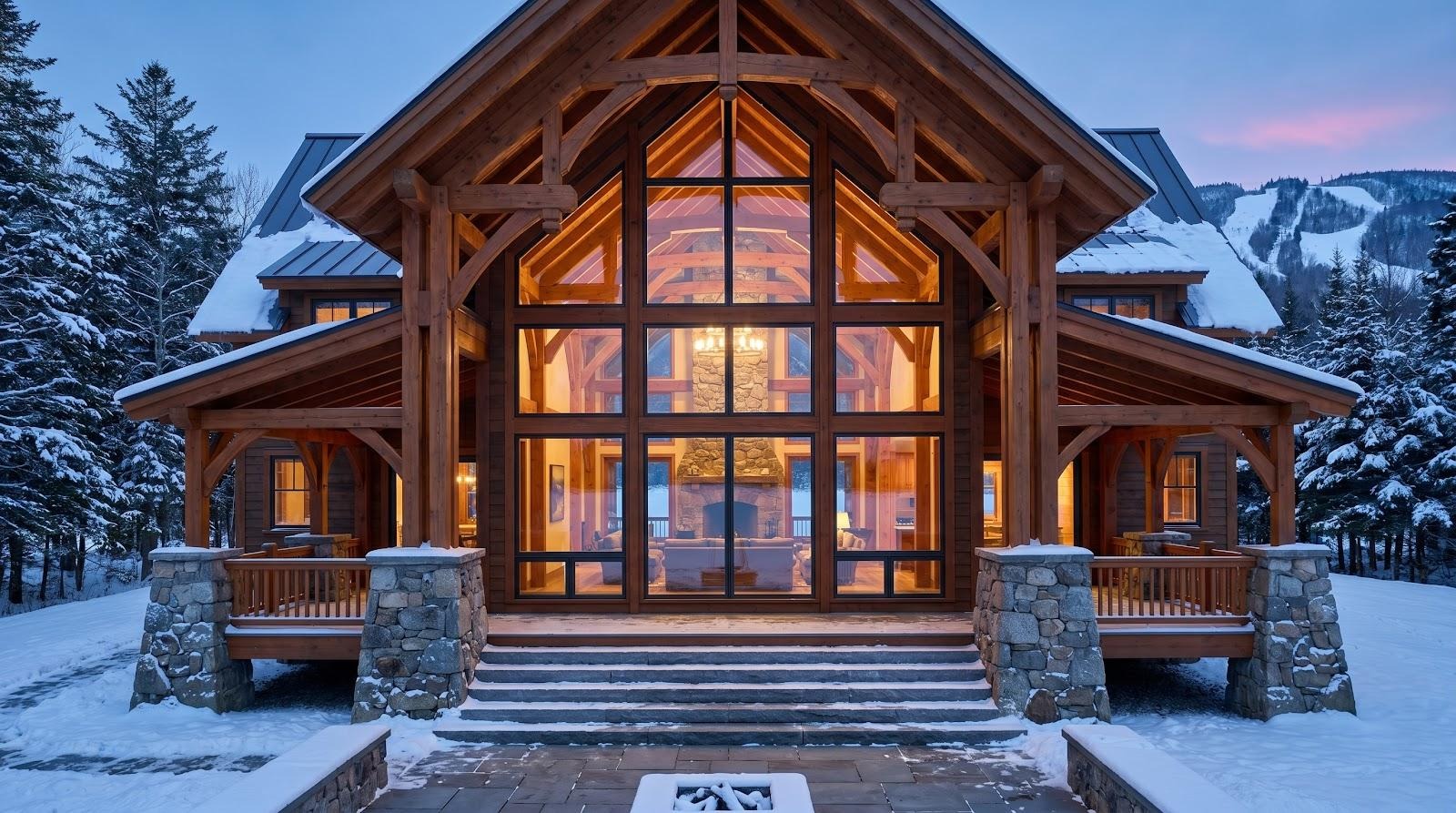
Some moments call for more elbow room—holiday reunions, summer weddings, or a big blended family. Rocky Mountain answers with 2,526 square feet of cathedral volume, three full bedrooms, and a bridge loft that turns every entrance into a jaw-drop moment.
Outside, a hammer-beam porch rests on stone piers and signals that this house means business. Wide steps lead into a soaring great room where a two-story window wall frames lake sparkle or ski-trail views like artwork.
All bedrooms sit upstairs, keeping the main floor free for cooking, dining, and late-night laughter. That separation is perfect when half the crew wants first tracks and the rest prefers cribbage after dark.
A screened-porch option tucks off the living room, giving you bug-free lobster boils in July and a sheltered spot to hang wool blankets by the fire pit in October.
Scale affects budget. Plan on $880,000–$1,250,000 turnkey at Maine rates. The cost per square foot stays efficient thanks to a straightforward rectangular shell. Wrap that shell in R-26 wall and R-42 roof panels, add ceiling fans to push warm air back down, and even a cavernous great room feels cozy.
Rocky Mountain is our go-big choice. If land, budget, and guest list are generous, this design delivers instant lodge charisma and memories that last for decades.
Hawaii Hale: single-level ease with a summer-porch soul
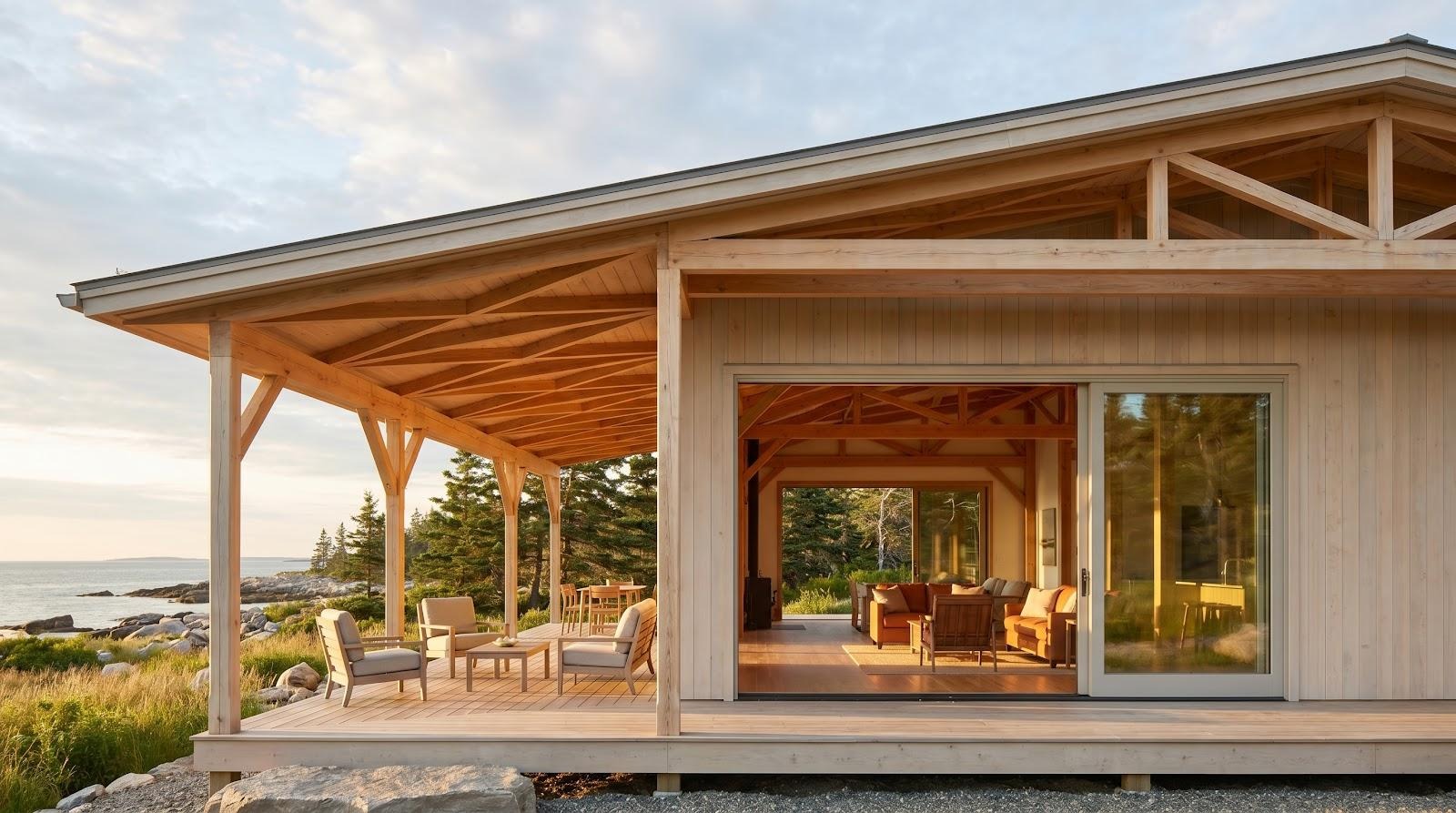
Hawaii Hale trades height for flow. Everything—kitchen, living, and bedroom—spreads gracefully across one 1,600-square-foot plane, making it the most accessible design in our lineup.
A scissor-truss ceiling lifts the great room, while a wall of glass slides open to a 580-square-foot covered lanai. Enclose the space with screens and you gain a three-season room for clam-bake dinners and rainy-day card games. Pull back the panels and you are living outdoors, Maine sea breeze included.
The plan shines for aging in place. No stairs to climb, generous hallway clearances, and a primary suite set apart from the bustle create true lifetime livability. Add lever handles and curbless showers and the house adapts as needs change.
Energy performance stays on point. A simple rectangle wraps easily in R-26 wall and R-42 roof panels, keeping heating costs low even on February nights. With the modest footprint, turnkey costs usually land between $560,000 and $800,000, depending on finish choices and porch upgrades. That makes Hawaii Hale a cost-wise pick for retirees or couples seeking a luxury guest cottage on family land.
This design proves you do not need multiple stories to enjoy the romance of exposed beams. One floor, endless porch, year-round comfort—an equation many Mainers will happily step into.
How to choose the timber design that fits your land, budget, and lifestyle
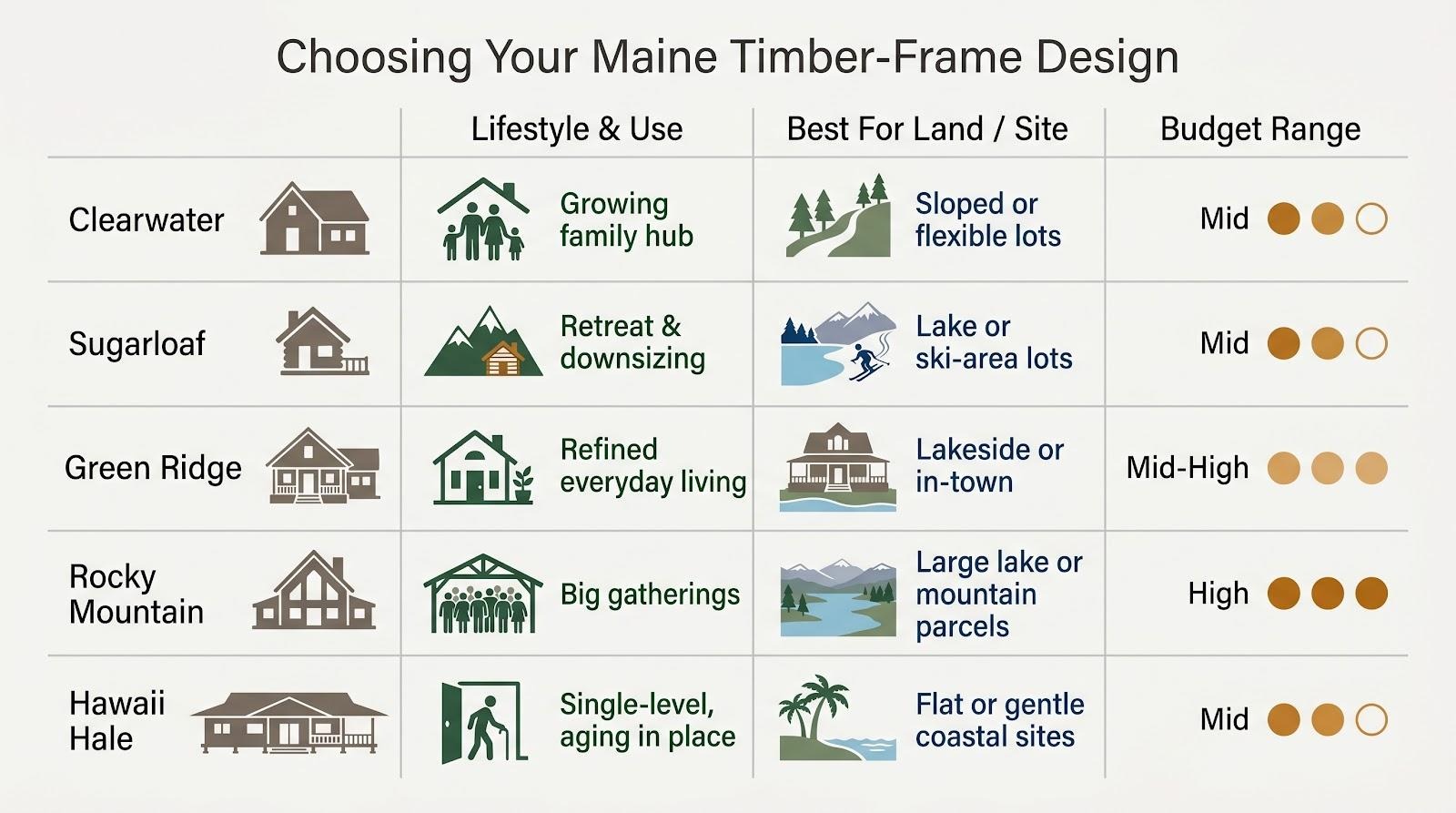
First, get clear on how you plan to live. Weekend retreat or year-round hub? A couple that travels may lean toward Sugarloaf’s modest square footage, while a growing clan will thank you later for Clearwater’s basement expansion.
Next, walk the site with a compass. A south-facing great-room window in Green Ridge can harvest free winter heat only if the trees, slope, and shoreline cooperate. Sloped lots favor walk-out basements, and flat coastal parcels appreciate a compact footprint that respects 20-foot setback rules.
Budget comes third, not last. Use the $350–$500 per heated square foot rule as a quick reality check, then layer in finish upgrades. If costs climb, trim complexity before trimming quality; timber frames keep their value when the details stay sharp.
Finally, talk early with a builder who knows timber. Hamill Creek Timber Homes models each custom frame in 3-D software and engineers every joint for the precise ground-snow load your Maine site demands.
Its enclosure package ships as pre-cut timbers and SIP wall and roof panels, so a crane crew can dry-in the shell within two to five days—an efficiency benchmark worth asking any builder to match. They will confirm snow-load specs, source local insulation, and plan the crane day so your frame rises in one smooth ballet. That partnership turns a floor plan into a Maine address you can hand down.
Your top timber-frame questions, answered
Are timber-frame homes really more efficient than stick-built?
Yes. Wood is a natural insulator, and when the frame is wrapped in structural insulated panels the walls reach about R-26 or higher, keeping Maine’s January drafts outside.
What should I budget per square foot?
Plan on $350–$500 per heated square foot for a turnkey build. Simple shells sit near the low end, while lodge-style plans with premium finishes land near the top. Use that range for early math, then request detailed quotes once your design is final.
How long does construction take?
From signed contract to housewarming party, allow 6–12 months. The frame itself lifts in days, but electrical, plumbing, and cabinetry define the full timeline. Timely decisions on fixtures keep momentum high.
Do I need special maintenance?
Only routine upkeep. Interior timbers stay dry, and exterior wood follows the same stain or paint schedule as any clapboard house. Keep gutters clear, refresh finishes every few years, and the beams will outlast you.
Can I customize these plans?
Yes. Because posts carry the loads, interior walls can shift with little fuss. A larger pantry, a screened porch, or a first-floor guest suite are all easy edits while the structural bones stay sound.
Conclusion
A timber frame is not just another way to build in Maine—it is the way that answers the state’s snow loads, salt air, and long winters with exposed joinery that only grows more handsome with age. Across these five designs, from the compact coastal cottage to the great-room lodge, the through-line is the same: engineered timber, tight thermal envelopes, and craftsmanship you feel the moment you walk in. Match the design to your site and your daily rhythm, work with a builder who has framed for Maine’s climate before, and you end up with a home that feels rooted the day you move in and only deepens its character for generations.





